

“How much will our custom software development cost?” is the first question every business asks. The honest answer is: it depends on what you’re building.
A booking tool for a small clinic and a SaaS platform for thousands of users are both “custom software.” One might cost $30,000. The other can pass $500,000.
And budgets are growing. Gartner expects global software spending to reach $1.43 trillion in 2026, up 14.7% in a year.
So instead of a made-up flat price, this guide explains what actually drives custom software pricing. You’ll also learn why quotes differ so much, how AI changes the numbers, and how to spot a quote that will grow later.
What Determines Custom Software Development Cost
Every software project budget comes down to two numbers: how many hours the work takes, and what each hour costs. Four levers move those numbers.
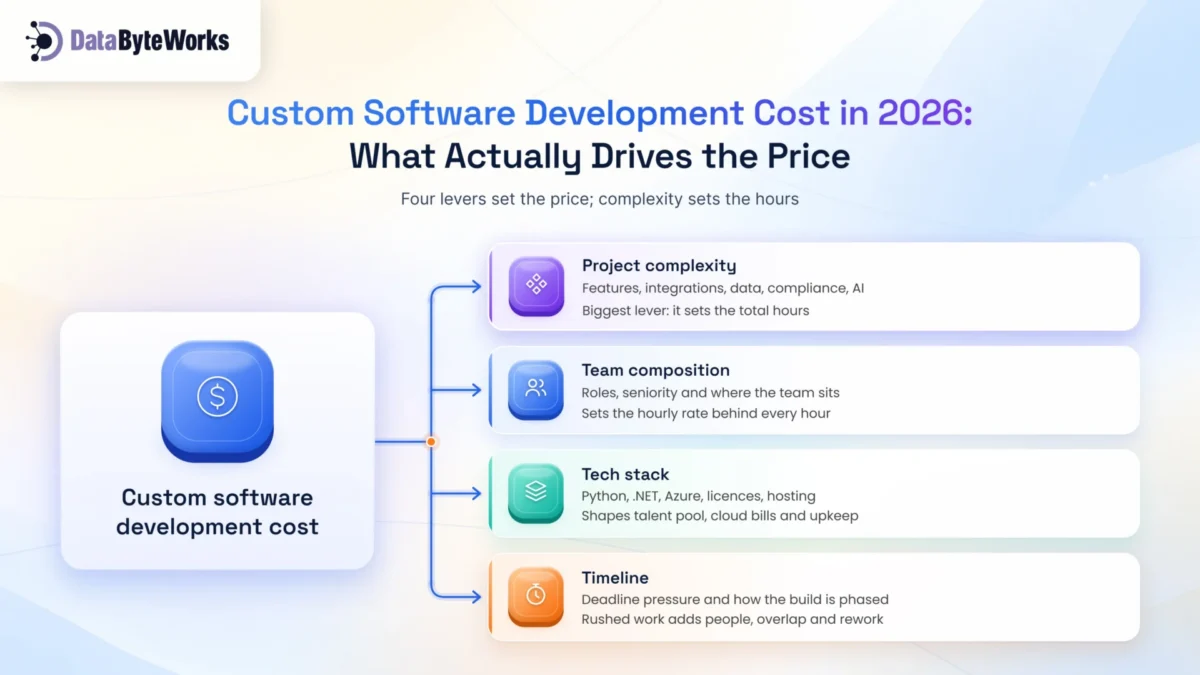
Complexity sets the hours. The team sets the rate. Stack and timeline push both up or down.
Why Two Quotes for the Same Idea Can Differ 4x
You send the same brief to three vendors and get $40,000, $90,000, and $160,000. Nobody is necessarily wrong. At the idea stage, there are too many unknowns.
Software experts call this the cone of uncertainty. A first estimate can be off by up to 4x in either direction. The range narrows as requirements and designs get settled.
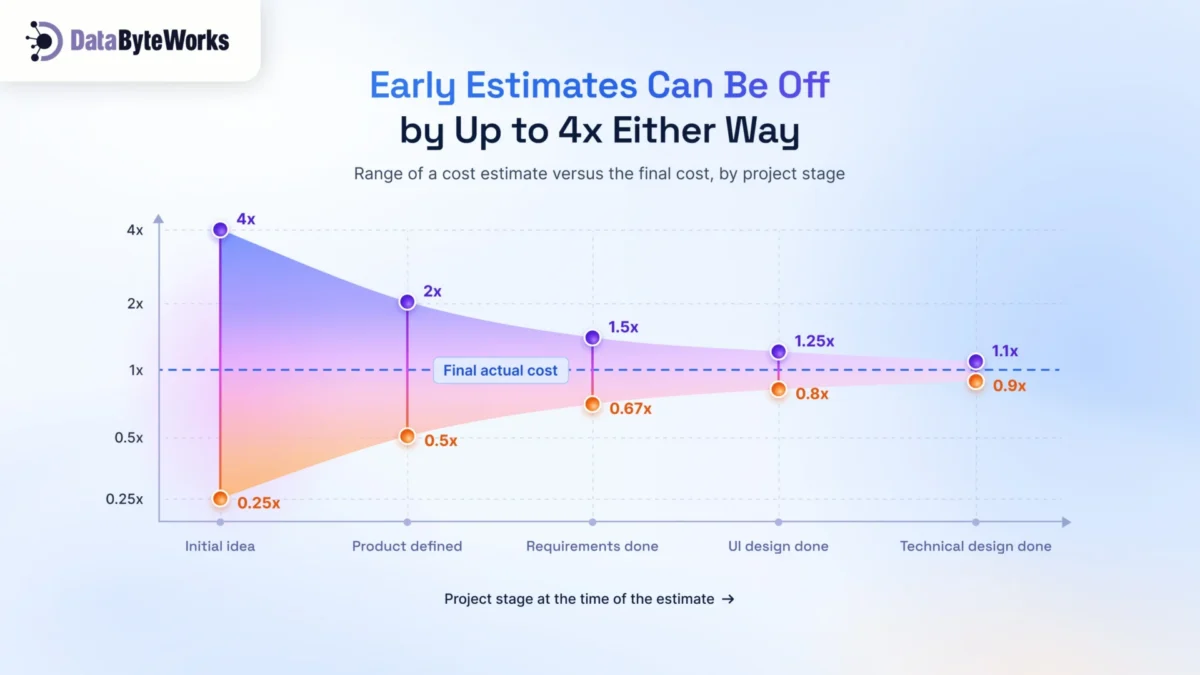
The takeaway: Treat early numbers as ranges. Pay for a short discovery phase first. A fixed quote is only reliable after the scope and designs are agreed.
Cost by Project Complexity
Complexity has the biggest effect on the cost of building software in 2026. Each extra integration, user role, or data rule adds hours and risk. The Standish Group’s 2020 CHAOS report found 90% of small projects succeed, but fewer than 10% of large ones do.
Simple Internal Tools and MVPs
Admin dashboards, approval workflows, booking tools, or a first product version. One or two user roles, a few core screens, few integrations.
Mid-Complexity Business Applications
Customer portals, CRM extensions, inventory systems, or mobile apps with a real backend. Several user roles, payments, reporting, and third-party integrations.
Complex, Enterprise-Grade or AI-Integrated Systems
Multi-tenant platforms, compliance-heavy systems (HIPAA, SOC 2, GDPR), legacy migrations, and AI-first products. AI adds data pipelines, testing of model output, and ongoing monitoring.
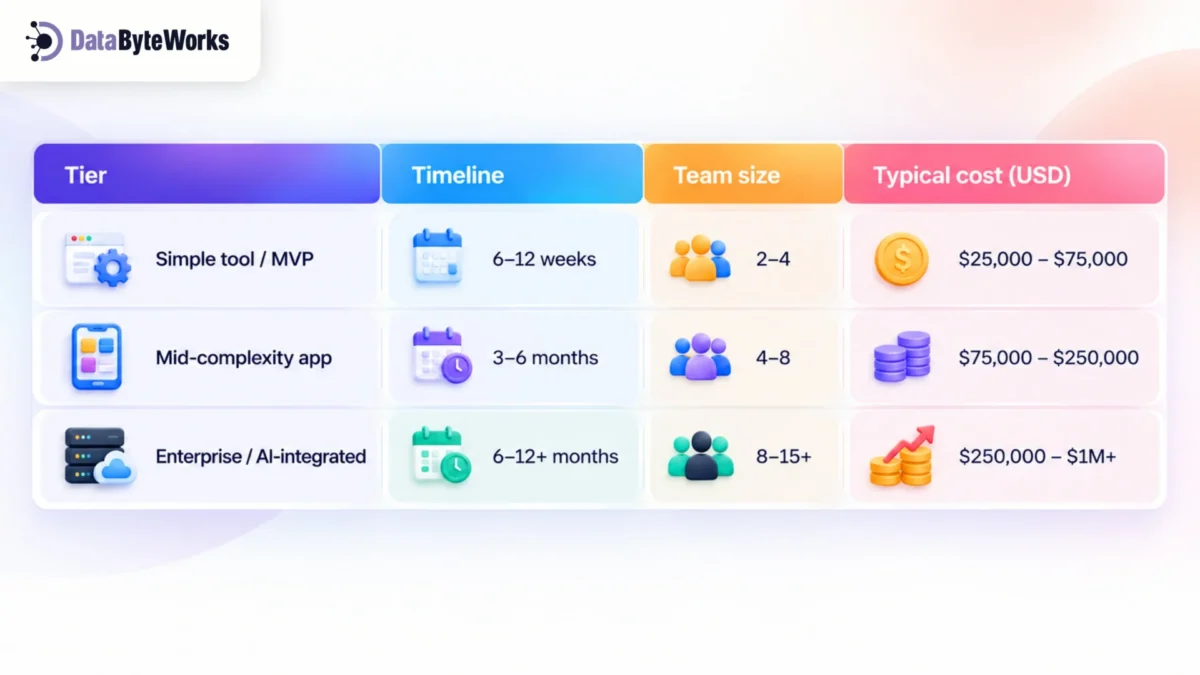
Indicative 2026 market ranges for blended teams. Your figure depends on scope, region, and team model.
Cost by Team Composition: Who You’re Actually Hiring
The team sets the hourly rate. A senior engineer costs more per hour but often finishes faster, with fewer bugs. Aim for the right mix of roles, not the lowest rate. For context, the U.S. Bureau of Labor Statistics puts the median U.S. software developer salary at $135,980 a year (May 2025), before benefits and overheads.
Python Developers
Python powers data-heavy backends, APIs, automation, and most AI features. If your product relies on analytics or AI, you’ll need to hire Python developers who know Django or FastAPI and modern AI libraries. AI and data skills sit at the top of the rate range. See our Python development services for how we staff these projects.
.NET Developers
.NET suits companies on the Microsoft stack, enterprise systems with strict security, and legacy Windows apps that need modernising. .NET development services are common in finance, healthcare, and manufacturing. Migration work costs more, so hire .NET developers who have done that type of migration before.
Azure Developers and Cloud Engineers
Cloud engineers decide how your software runs, scales, and stays secure. Good design upfront lowers monthly hosting bills and avoids rebuilds. Azure cloud developers cost more for multi-region setups, Kubernetes, or AI workloads, but specialist Azure development services often pay for themselves through lower running costs.
| Region | Mid-level (USD/hour) | Senior (USD/hour) |
| United States / Canada | $100 – $150 | $150 – $250 |
| Western Europe / UK | $70 – $120 | $110 – $180 |
| Eastern Europe | $40 – $70 | $60 – $100 |
| India / South Asia | $25 – $45 | $40 – $75 |
Indicative 2026 agency rates. AI and cloud architecture specialists sit at the top of each range.
In-House vs. Outsourced vs. Freelance: How Sourcing Changes the Number
Hourly rates tell only half the story. Compare the total cost of delivering custom software development services, including hiring time, management effort, and risk.
| Factor | In-house team | Software development company | Freelancers |
| Time to start | 2–6 months to hire | 1–4 weeks | Days |
| Real cost | Salary + benefits, tools, office, recruiting | Agreed rate or fixed scope | Hourly or per task |
| Skills | Only who you hire | Dev, QA, design, cloud, PM | Usually one skill each |
| Delivery risk | Medium | Low to medium | High on large projects |
| Best for | Long-term core products | Most new builds | Small, isolated tasks |
For most new builds, a custom software development company offers the best balance: a full team from week one and no idle salaries. A good software development company also brings proven processes, which lowers risk.
Pick the Right Pricing Model, Too
Most buyers compare rates and forget the contract type. It can matter just as much.
| Pricing model | How you pay | Works best when | Watch out for |
| Fixed price | One agreed price for a defined scope | Scope is small and clear | Vendors add a risk buffer; every change costs extra |
| Time and materials | Actual hours at agreed rates | Scope will change as you learn | Needs regular budget check-ins |
| Dedicated team | Monthly fee for a full team | Long-term or growing products | You manage priorities |
A useful mix: Fixed price for discovery and the MVP, then time and materials once the product is live.
SaaS Product Development Cost vs. Custom Internal Software
An internal tool serves one company you control. A SaaS product serves many customers you don’t. That difference often adds 30% to 50% to the build.
Why SaaS Builds Cost Differently
| Factor | Internal software | SaaS product |
| Users | Your own staff | Many external customers |
| Architecture | Single company | Multi-tenant: each customer’s data kept separate |
| Scale | Known, stable user count | Must grow from 10 to 10,000 users without a rebuild |
| Extra features | Not needed | Billing, plans, self-serve sign-up |
| After launch | Mostly maintenance | Constant new releases |
What a SaaS Product Development Company Adds to the Cost-Value Equation
A specialist SaaS product development company has already solved multi-tenancy, billing, and scaling. That means fewer costly architecture mistakes. Good SaaS development services also cover what first-time founders miss, like usage analytics and tenant-level permissions. The rate may be higher, but expert SaaS application development usually lowers the total cost of reaching a stable, sellable product.
How AI Changes Software Costs in 2026
AI affects your budget in two separate ways, and most cost guides mix them up.
- AI coding tools: helpful, but not a guaranteed discount. Be careful with vendors who promise big savings just because they use AI. In a 2025 METR study, experienced developers using AI tools took 19% longer on real tasks, even though they believed they were 20% faster. Savings come from good process, not from the tools alone.
- AI features: a new running cost. A chatbot, smart search, or document reader costs money every time someone uses it. Budget for:
- Data preparation and cleaning before the build
- Testing and checking the quality of AI answers
- Monthly usage fees for AI models, which grow with your users
- Monitoring, so answers stay accurate over time
Ask any vendor for an estimate of monthly AI running costs at your expected usage, not just the build price.
Hidden Costs Most Estimates Miss
This is the “why did it cost more than the quote?” section. A McKinsey study of 5,400+ IT projects found large ones ran 45% over budget on average. Much of that comes from costs nobody planned for:
- Maintenance: bug fixes, security patches, library updates (15–20% of build cost a year)
- Security and compliance: audits, penetration tests, certifications
- Integrations and licences: payment gateways, APIs, maps, AI usage fees
- Cloud hosting: grows as your users grow
- Post-launch changes: new features driven by real user feedback
- Scope creep: small “can we also add…” requests that add up
The simplest way to see the full picture is a three-year view. Here’s an example for a $100,000 build:
| Cost item | Year 1 | Year 2 | Year 3 |
| Initial build | $100,000 | — | — |
| Maintenance and support | Included (warranty) | $15,000 – $20,000 | $15,000 – $20,000 |
| Hosting and licences | $6,000 – $12,000 | $6,000 – $12,000 | $6,000 – $12,000 |
| Improvements after launch | $10,000 – $25,000 | As needed | As needed |
| Total | $116,000 – $137,000 | $21,000 – $32,000 | $21,000 – $32,000 |
Over three years, the real cost is about 1.6x to 2x the build price. Plan for it now, and year two won’t be a surprise.
How to Control Custom Software Development Costs Without Cutting Corners
Cutting quality to save money backfires: bugs and rebuilds cost more later. These steps lower expenses and keep the product solid.
- Build in phases – Launch the must-have features first. Use what you learn to plan the next phase.
- Write a clear scope – List features, user roles, integrations, and what’s out of scope. It’s the fastest route to an accurate estimate.
- Right-size the team – A small team of the right specialists beats a big team that needs heavy coordination.
- Choose the tech stack early – Changing stacks mid-project is one of the costliest mistakes.
- Reuse proven building blocks – Cloud services, open-source libraries, and existing APIs save weeks.
Red Flags in a Software Quote
A low quote can become the most expensive one. Look twice if a quote:
- Gives a fixed price without a discovery or scoping step
- Shows one total with no breakdown by phase or role
- Leaves out testing, deployment, or project management
- Says nothing about maintenance, hosting, or AI running costs
- Has no clear process for handling change requests
How DataByteWorks Prices Custom Software Development
As a leading custom software development company – DataByteWorks doesn’t give a number before we understand the problem. Here’s how pricing works:
- Discovery call: your goals, users, timeline, and budget range.
- Scope and architecture review: features, integrations, and the right stack, whether Python, .NET, Azure, or a mix.
- Itemised estimate: costs by phase, role, and hours, so you see where every dollar goes.
- Phased delivery: a demo at each milestone, and your approval before the next phase.
- Post-launch plan: maintenance and support priced upfront.
As an AI development company, we also build AI-powered features such as smart search, document processing, and chat assistants. We price AI running costs separately, so there are no surprises after launch.