

Introduction
The right development team can turn your roadmap into reality. Keep the work that defines your product close, and outsource when you need specialist skills, faster delivery, or room to grow. In 2026, a mix of in-house talent and a dedicated outsourced team can offer the best of both worlds.
This guide compares in-house vs. outsourced development across cost, speed, control, and risk, with 2026 cost estimates and a practical checklist to help you choose.
In-House vs Outsourced Development at a Glance
| Factor | In-house team | Outsourced (dedicated team) |
| Cost per developer (US vs offshore) | ~$190,000/year fully loaded | ~45,000–65,000/year |
| Time to start | 2–3 months per hire | Typically 1–4 weeks |
| Scaling up or down | Slow; layoffs are costly | Add or release people with notice |
| Day-to-day control | Full | High with a dedicated team; lower with fixed-price projects |
| Product and domain knowledge | Builds up and stays | Builds up, but must be documented to stay |
| Specialist skills (AI, cloud, data) | Hard and expensive to hire | Available from the vendor’s bench |
| Communication | Same office or time zone | Needs set overlap hours and written process |
| Attrition risk | Yours to manage (13–21% a year in tech) | Vendor replaces people; you manage handover |
The cost and hiring figures are explained, with sources, in the cost section below.
In-House Development: Where It Wins and Where It Hurts
An in-house team is the strongest choice for work that is permanent, central to your product, and depends on deep knowledge of your business.
Where it wins
- Product ownership. The people who decide what to build and how the system fits together should sit inside the company. That includes product managers, architects and tech leads.
- Knowledge that compounds. Engineers who stay for years understand your customers, your data and why past decisions were made. That speeds up every later feature.
- Fast decisions. Fewer handoffs, same working hours, no contract changes when priorities shift.
- Sensitive work. Some regulated or government work restricts third-party access to systems or data.
Where it hurts
- Cost. As per Apollo Technical, the BLS median US software developer salary was $135,980 in May 2025. Benefits add roughly 30% on top, so one developer costs about $190,000 a year before equipment, licences and recruiting.
- Time to hire. A direct hire usually takes two to three months from job description to start date (same source). That’s a quarter of the year per role.
- Attrition. Stealth Agents reports that Tech attrition runs 13–21% a year, and replacing an engineer costs 50–200% of annual salary.
- Fixed capacity. A team sized for a busy roadmap sits under-used in a quiet quarter, and a team sized for a quiet quarter can’t absorb a big launch.
Software Development Outsourcing: Three Models, Not One
“Outsourcing” covers three quite different setups. Most bad outsourcing experiences come from picking the wrong one for the job.
Project-based (fixed scope)
The vendor delivers a defined product for an agreed price and date. It works for well-understood builds with a clear end, like a marketing site, a one-off integration or an MVP with a frozen scope. It works poorly when requirements will change, because every change becomes a negotiation.
Dedicated development team
A team that works only on your product, full time, under your direction. You set priorities in your sprint process, and the vendor handles hiring, payroll, equipment and replacements. This is the closest outsourcing gets to an in-house team. It fits ongoing product development where the roadmap keeps moving.
Staff augmentation
Individual engineers join your existing team to fill specific gaps, like a React developer, an Azure engineer or a QA lead. Your managers run them day to day. It’s the fastest way to add capacity without changing how your team works.
Outsourcing pros and cons
| Pros | Cons |
| Lower cost per developer, especially offshore | Less direct control, especially on fixed-price projects |
| Start in weeks, not months | Communication overhead across time zones |
| Specialist skills on demand (AI, cloud, data) | Product knowledge can leave with the vendor if not documented |
| Scale up or down with the roadmap | Security and IP need clear contracts and access controls |
| Vendor absorbs hiring and attrition | Quality varies widely between vendors |
Why companies outsource has also changed. In Deloitte’s 2024 Global Outsourcing Survey, only 34% named cost reduction as their main driver, down from 70% in 2020. 42% now cite access to specialized talent first. Teams outsource less to save money and more to get skills they can’t hire fast enough.
What Each Model Really Costs in 2026
A five-person team costs about $950,000 a year in-house in the US, against roughly 225,000-315,000 for an offshore dedicated team. Here’s how those numbers are built.
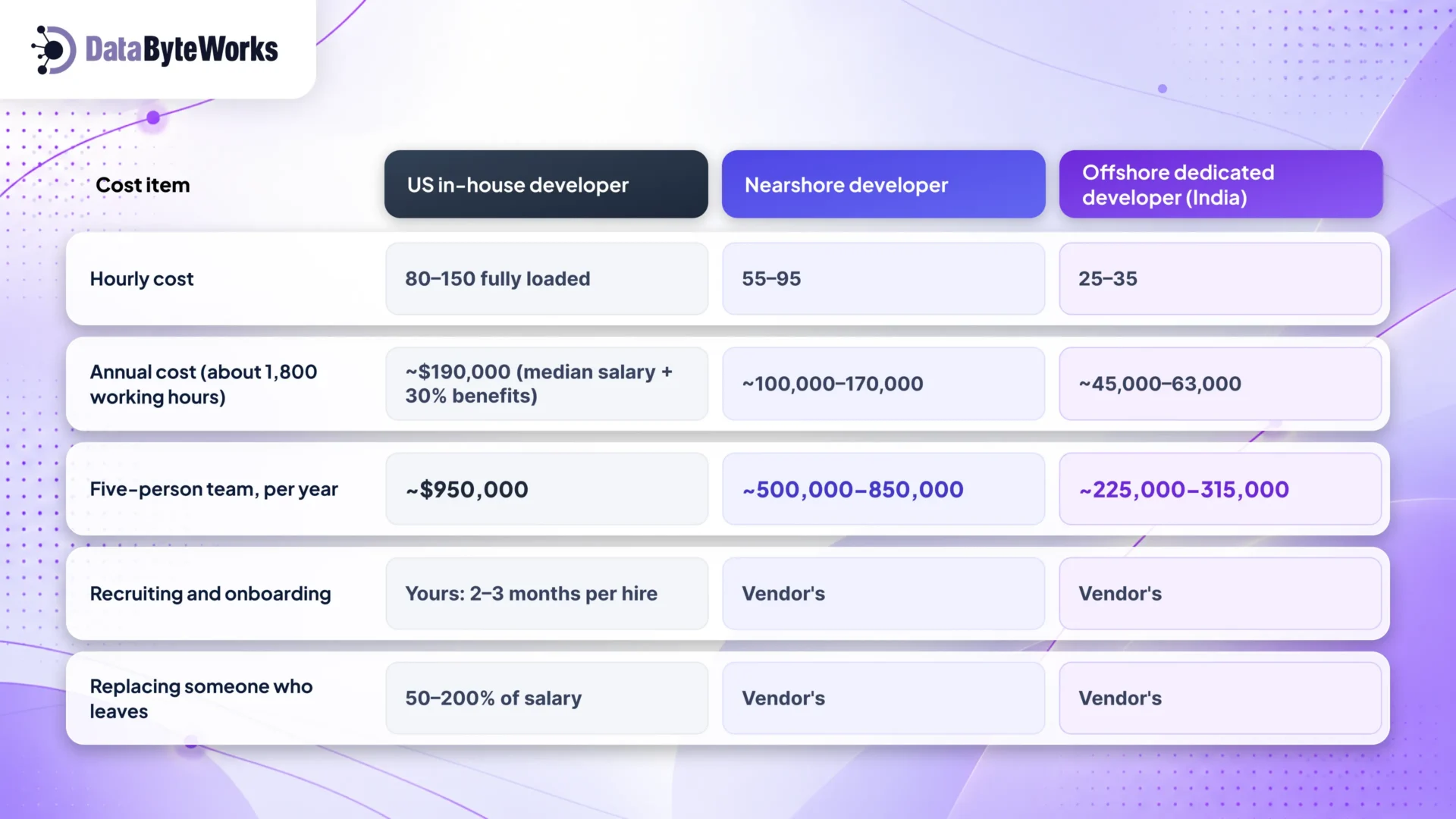
Sources: US salary and benefits from BLS data via Apollo Technical. US loaded hourly, offshore India rates and replacement cost from Stealth Agents. Nearshore rates from Wednesday Solutions. Annual figures are hourly rate × 1,800 hours, rounded.
The offshore number isn’t the whole cost. Budget for:
- Your own management time. Someone in-house still owns priorities, reviews and acceptance. Plan for a product owner or tech lead to spend real time with the team.
- Overlap hours. Two to four hours a day of shared working time keeps decisions moving. Offshore teams serving the US often shift their day to make this work.
- Ramp-up. Expect the first 4–6 weeks to be slower while the team learns your codebase and domain.
Even after those costs, the gap is wide enough to favour outsourcing for most work outside your core product team.
The Hybrid Model: How Most Teams Actually Do It
For most companies the real answer isn’t either/or. Keep a small in-house core, and surround it with a dedicated outsourced team that scales with the roadmap. Large companies are moving the same way: Deloitte found 78% of organizations now use their own global in-house centers alongside outside vendors.
A typical split:
| Keep in-house | Give to the dedicated team |
| Product management and roadmap | Feature development against the roadmap |
| Architecture and key technical decisions | QA, test automation and regression testing |
| Security policy and access control | Integrations, data pipelines and reporting |
| Customer-facing domain expertise | Legacy maintenance and modernization |
| Final code review and release approval | Specialist work: cloud migration, AI features, mobile apps |
Integration work is often the easiest first piece to hand over, because the scope is clear and testable. Our guide to API integration strategy covers how to scope it so any team, in-house or outsourced, can build against it.
What this looks like in practice. A US revenue-protection services company serving logistics and transportation firms has worked with DataByteWorks for several years. The team built and now supports its cloud-based data platform on Microsoft MVC, SQL Server and Azure. The client’s own team kept business ownership.
Our team handled application development, database engineering and cloud infrastructure. In the client’s published review, they describe the arrangement as a long-term partnership that delivered a stable, scalable platform with faster issue resolution.
Another client put the time-zone difference in a positive light. Because our working day falls during the night, work moves forward around the clock, a “follow the sun” model. That only works with clear handover notes at the end of each day. AI tools now make those notes much cheaper to produce: summarizing pull requests, drafting documentation and turning tickets into test cases.
If you’re weighing a similar split for a specific product, our guide to enterprise mobile app development: build vs buy covers how the same thinking applies to a mobile roadmap.
Which Model Fits Your 2026 Roadmap? A Checklist
Start with where your roadmap is today. The right model usually follows from that.
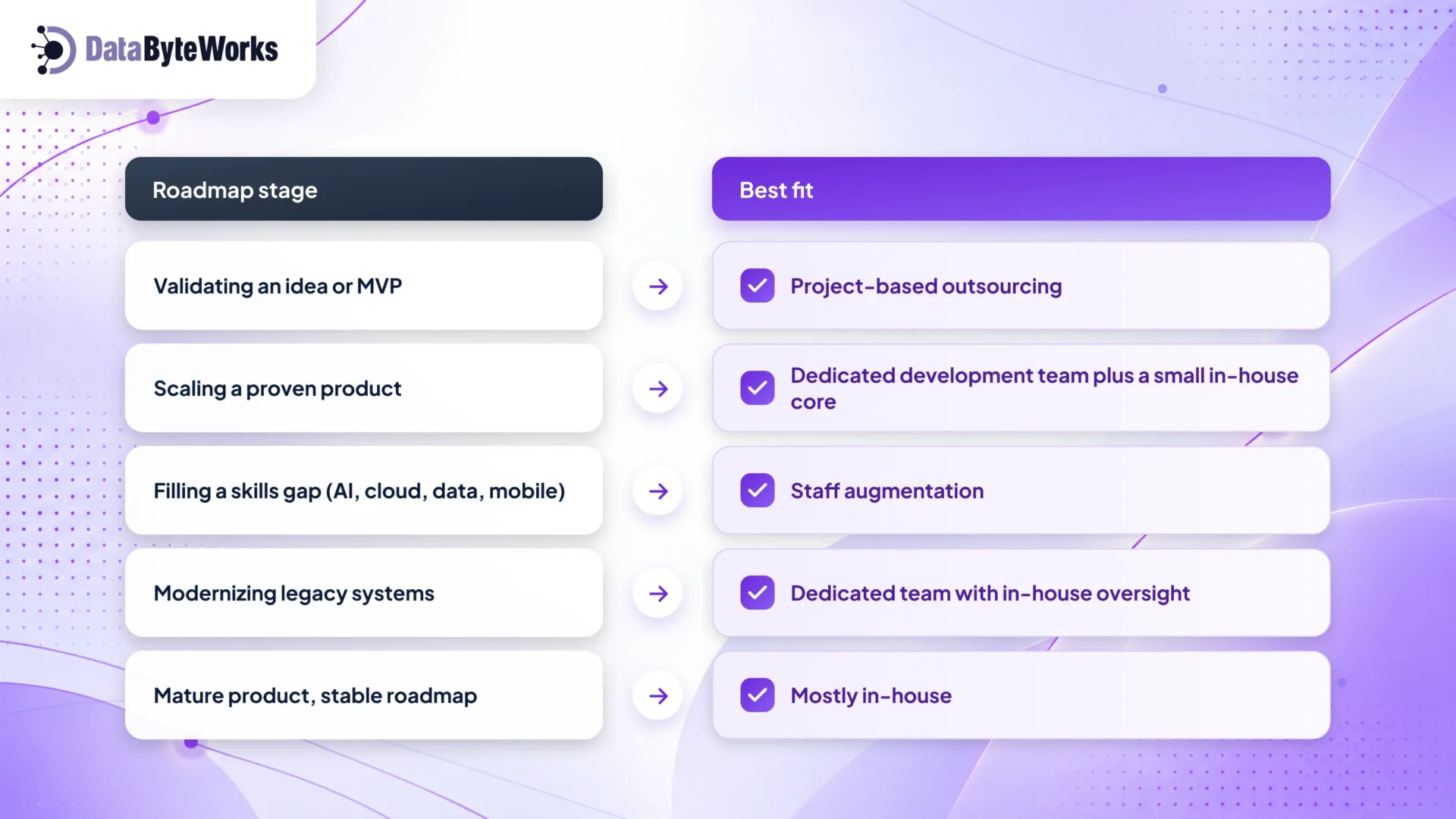
Then answer these questions. The more “yes” answers you have, the stronger the case for outsourcing:
- Do you need people working within the next 30 days?
- Is the skill you need hard to hire locally, or needed for less than a year?
- Will workload rise and fall over the next 12–18 months?
- Is a full in-house team over budget for this year?
- Do you have someone in-house who can own priorities and review the work?
The last question matters most. Without an internal owner, any outsourced team (and most in-house teams) will drift.
How to Hire Offshore Developers Without the Usual Risks
Most offshore failures come from the setup, not the location. Six steps prevent the common ones.
- Run a paid trial. Start with a 2–4 week piece of real work before committing to a full team. You’ll learn more about code quality and communication than any interview shows.
- Interview the actual people. Meet the developers who will work on your product, not only the sales team. Ask them to walk through code they’ve written.
- Agree on overlap hours. Set 2–4 hours of shared working time a day, and put it in the contract.
- Own your code and accounts. Code goes in your repository and cloud resources run under your accounts from day one. The contract should assign all IP to you.
- Control access. Give each person their own login with the least access they need, use your SSO, and remove access the day someone leaves.
- Write things down. Decisions, architecture notes and handovers go in your wiki, not someone’s inbox. That protects you if team members change.
The same process applies whether you’re adding one specialist or a full team. If you’re building a cross-platform app, for example, you can hire React Native developers and run exactly this trial before scaling up.
Not Sure Which Model Fits Your Roadmap?
Tell us what you’re building, your timeline and your current team. We’ll recommend the split between in-house and outsourced work, and if a dedicated team makes sense, we can start with a short paid trial so you see the work before you commit.