

Offshore software development in India for US companies usually costs $20-50 per engineer per hour. That is about 40–60% less than a similar US team, even after you pay for project management and extra testing. East Coast teams can get 3–4 hours a day when both sides are online; West Coast teams get 1–2 hours for the same case. The bigger risk isn’t cost or time zones, but picking the wrong partner. So, test any partner with a small paid project before you sign a long contract.
What Offshore Software Development means for a US company
Offshore software development means a team in another country, usually many time zones away, builds or maintains software for you. The engineers work for a partner company in that country. You decide what gets built. The partner hires the engineers, pays them, and gives them an office and equipment.
People often mix this up with “outsourcing” and “staff augmentation.” Here’s an easy way to tell them apart: offshore is about where the team works. Outsourcing and staff augmentation are about who is responsible for the result.
| Model | Where the team is | Who runs the work | Good fit for |
| Offshore dedicated team | Far away (e.g., India) | You set priorities; the partner handles hiring, pay, and equipment | A SaaS company shipping new features every sprint |
| Project outsourcing | Anywhere | The partner delivers an agreed scope | A one-time build, such as a customer portal |
| Staff augmentation | Anywhere | You manage each person day to day | Adding one React developer to your own team |
| Nearshore | Nearby (Latin America for the US) | Varies | Work that needs lots of live calls |
| Onshore | Same country | Varies | Highly regulated or customer-facing work |
Indian offshore teams most often handle custom web and mobile apps, testing, cloud and DevOps work, upgrading old systems, maintenance, and more and more AI and data work. If you’re not sure whether to add individual engineers or hire a whole team, read our comparison of staff augmentation vs. a dedicated team.
Offshore Software Development Cost: India vs. nearshore vs. onshore
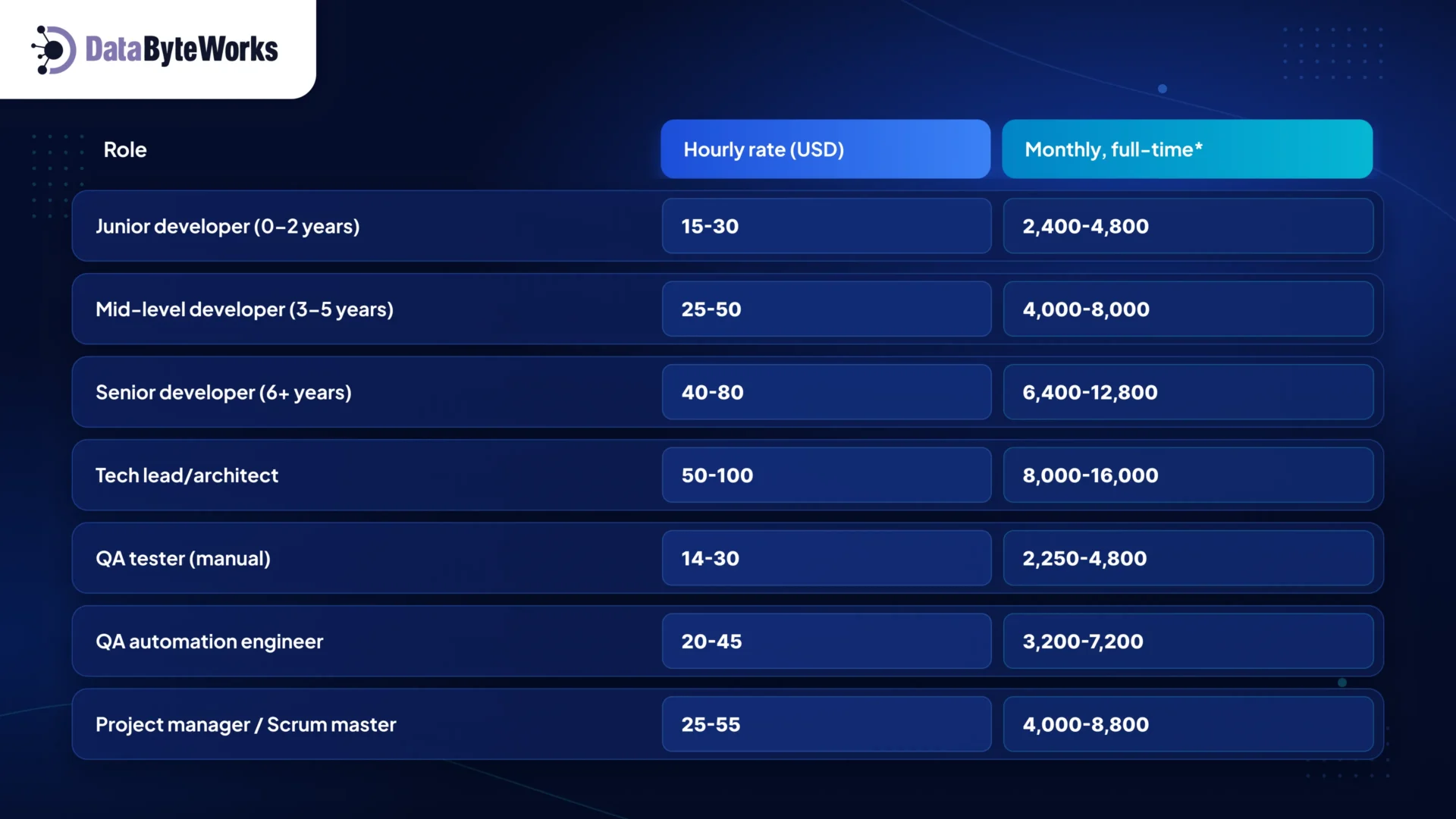
“India is cheaper” dialogue doesn’t help you build a budget. Prices depend on the role, experience level, and tech stack. Here are typical 2026 rates.
What each role costs in India
Nearshore vs. Offshore vs. Onshore
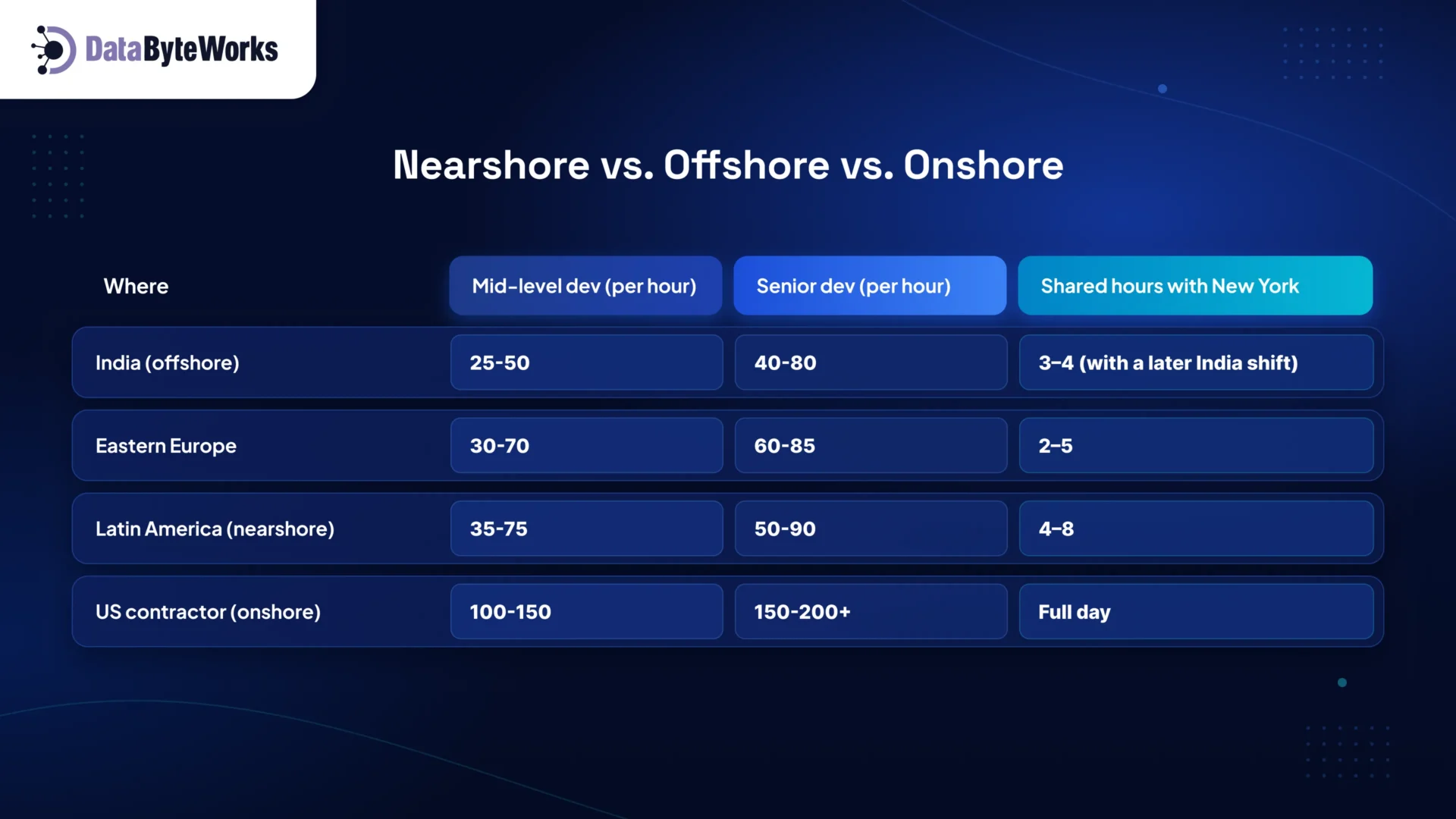
With nearshore, the higher price buys you more shared working hours. With India, you get the lowest rates and the biggest talent pool, but you need a good routine for working across the time gap. The time zone section below shows how.
Costs the Hourly Rate Doesn’t Show
- Getting up to speed. A new team usually needs 2–6 weeks to learn your codebase before it works at full speed. Plan for it.
- Redoing work. A cheap team that needs constant fixes often costs more than a careful one. For example, a team at $55 an hour that gets it right can cost less overall than one at $30 an hour that keeps needing corrections.
- Management and testing. Project management, QA, and fixes usually add 15–30% on top of developer rates. Ask whether these are included in the quote.
- Too many juniors. An all-junior team looks cheap and then moves slowly. Aim for about one senior engineer for every three or four others.
- Your own time. Someone on your side has to answer questions, set priorities, and review work. Count those hours too.
Example: What a 4-Person Team Costs for a Year
Example (hypothetical): a 60-person fintech startup in Austin needs one senior developer, two mid-level developers and one QA automation engineer to build its lending dashboard. Here’s the cost at mid-range rates:
| India team | US contractors | |
| Team cost per hour | 169(60 + $38 + $38 + $33) | 535(175 + $125 + $125 + $110) |
| Per month (160 hours) | $27,040 | $85,600 |
| Add 20% for management, QA and fixes | $32,448 | Not added |
| Per year | about $389,000 | about $1,027,000 |
Even when you add 20% to the India side, the startup saves roughly 62%, about $638,000 a year. That only holds if the team is well run. A poorly managed team can lose most of those savings to rework and delays.
How AI Changes the Math
AI coding tools now write a lot of first-draft code, tests, and documentation. That makes the people who check and fix that code more valuable. In practice, a team with more senior reviewers is worth paying a bit more for.
Ask every partner two questions:
- Who reviews AI-written code before it ships
- How do they keep your data and passwords out of AI tools?
India–US Time Zone Overlap: The Hours that Actually Work
India runs on India Standard Time (IST) all year and doesn’t change its clocks. The US does, on the second Sunday in March and the first Sunday in November. So the gap changes by an hour twice a year, and your regular meetings will move unless you plan for it. A time zone converter helps when scheduling.
| US time zone | India is ahead by (Nov–Mar) | India is ahead by (Mar–Nov) |
| Eastern (New York) | 10 hours 30 min | 9 hours 30 min |
| Central (Chicago) | 11 hours 30 min | 10 hours 30 min |
| Pacific (San Francisco) | 13 hours 30 min | 12 hours 30 min |
A normal Indian workday (about 9:30 AM–6:30 PM IST) doesn’t overlap with US office hours at all. That’s why good partners run a later shift for US clients, about 12:30 PM–9:30 PM IST. Here’s what that gives you, assuming your team works 8 AM–5 PM:
| Your team is in… | Shared hours (winter) | Shared hours (summer) | What to do |
| US East | 8:00–11:00 AM ET (3 hours) | 8:00 AM–12:00 PM ET (4 hours) | Do standup and decisions first thing in the morning |
| US Central | 8:00–10:00 AM CT (2 hours) | 8:00–11:00 AM CT (3 hours) | Use shared time only for meetings that need both teams |
| US West | None by default; the India lead can stay until 11:30 PM IST for 8:00–10:00 AM PT | 8:00–9:00 AM PT (1 hour) | Rely on written handoffs; add a 5–6 PM PT call, which is 6:30–7:30 AM in India |
Simple Rule: Protect 2–3 shared hours every workday. Use them only for things that need both teams live: standups, unblocking problems, design reviews, sprint planning, and urgent fixes. Everything else can happen in writing.
Example: A Working Day for an Atlanta Team (winter)
Example (hypothetical): a logistics software company in Atlanta works with a 5-person team in India on the 12:30–9:30 PM IST shift.
| Atlanta time (ET) | India time (IST) | What happens |
| 8:00 AM | 6:30 PM | 15-minute video standup with both teams |
| 8:15–11:00 AM | 6:45–9:30 PM | Atlanta team reviews code, answers questions, makes decisions |
| 11:00 AM | 9:30 PM | India team logs off |
| 5:00 PM | 3:30 AM (next day) | Atlanta team writes a short handoff note on each open task |
| 2:00–8:00 AM (next day) | 12:30–6:30 PM | India team builds, tests and records short demo videos |
| 8:00 AM (next day) | 6:30 PM | Finished work is waiting for review, and the cycle repeats |
This is called “follow-the-sun” development: work keeps moving while your US team sleeps.
What goes wrong without shared hours
- Every question costs a day. A feature with three open questions slips three days.
- Code reviews pile up, so changes go live in big, risky batches.
- Outages wait if no one on either side can fix things during the other team’s night.
- Guesswork creeps in. Engineers fill gaps with assumptions, and you pay for the rework later.
The fix is good habits, not more meetings: write down decisions, make sure every task has clear “done” criteria before it goes to India, record short demos, and name one on-call person on each side.
Offshore Development Center vs. Project-Based Work
An offshore development center (ODC) is a team that works only for you, based at your partner’s office. You decide what they work on. The partner handles hiring, HR, salaries, office space, equipment, and local paperwork. In project-based work, you pay a vendor to deliver a fixed scope, usually with engineers who also work on other clients’ projects.
| Offshore development center (ODC) | Project-based | |
| How long | Ongoing, usually a year or more | Weeks to months |
| Team | The same named engineers, only on your work | Shared engineers who may change |
| Pricing | Monthly fee per person | Fixed price, or hourly for the project |
| Control | You set priorities every sprint | The vendor follows the agreed plan |
| Knowledge | Builds up over time | Leaves when the project ends |
| Good for | Ongoing product work, scaling your team | MVPs, one-time builds, data migrations |
Choose an ODC when:
- You have a year or more of work planned.
- You need four or five engineers or more, and expect to grow.
- Industry knowledge matters, as in logistics software development, fintech, or healthcare. The longer the team stays, the more it knows.
- You want the team to use your tools, processes, and coding standards.
- You may later want to take the team in-house as your own India office, sometimes called “build-operate-transfer.”
Choose project-based work when:
- The scope is fixed and clearly written down.
- It’s a one-time job with no long-term upkeep.
- You want to test a new partner before committing to a full team.
Example (hypothetical): A 120-person healthcare SaaS company in Nashville has a two-year product roadmap and needs six engineers, so an ODC makes sense. The same company also needs a one-time move of data out of an old billing system. That’s a good fit for a fixed-price project.
A Real Example: DataByteWorks and a US Logistics-Services Firm
Since January 2022, a DataByteWorks team of 2–5 people has worked with a revenue protection services firm in New Jersey that serves logistics and transportation companies. The team designed, built, and now supports a secure cloud platform that collects, analyzes, and reports on large amounts of data. It runs on ASP.NET, SQL Server, and Azure, and the team also manages the Azure infrastructure.
In its verified Clutch review, the client reports fewer performance problems, steady response times during peak load, and that the platform grew without needing its architecture rebuilt. The client also said our turnaround could be faster during busy periods. That’s useful feedback, and it’s why the checklist below says to agree on response times in writing.
How to Choose an Offshore Software Development Company in India
Most vendor websites look the same. Use this checklist to compare partners on proof, not promises.
1. Check their past work
- Ask for two or three case studies in your industry, with US clients you can call.
- Read their reviews on independent sites (Clutch, G2, GoodFirms), especially what clients say could be better.
- Make sure they’ve worked with companies your size. A 20-person startup and a 2,000-person enterprise need different things.
2. Make sure they know your tech stack
- Get CVs for the exact engineers who will work on your project.
- Interview those engineers yourself, ideally on a real problem from your code. For a Microsoft-based product, for example, meet the people before you hire .NET developers.
- Ask how they use AI coding tools and who checks AI-written code.
3. Protect your code and data
- Sign an NDA (non-disclosure agreement) before you share anything sensitive.
- Make sure the contract clearly says you own all the code and designs as they’re created.
- Check that every engineer has signed confidentiality and IP agreements with the partner.
- Keep code in your own GitHub, GitLab, or Azure DevOps account, with logins you can turn off on day one.
- Ask for security proof such as ISO 27001 certification or a SOC 2 report.
- Ask how they’re preparing for India’s new data protection law, the DPDP Act.
Disclaimer: This checklist is general guidance, not legal advice. Have your lawyer review the contract.
4. Start with a paid trial
- Run a 2–4 week paid trial on a real task, not a toy exercise. An older part of your system makes a good test (our legacy modernization checklist shows what to look for).
- Judge the code quality, the questions they ask, whether their estimates were right, and how clearly they report progress.
Example (hypothetical): A logistics software company in Dallas gave three shortlisted vendors the same two-week paid task: add a shipment-tracking API with tests. Vendor A finished on time, wrote tests, and asked four sharp questions on day one. Vendor B finished a day early but skipped tests. Vendor C missed the deadline. The company chose Vendor A, even though it was $6 an hour more expensive.
5. Agree how you’ll work together
- Put the shared hours and response times in the contract.
- Get a named delivery manager, a clear escalation path, and a weekly progress report.
- Ask how many engineers leave each year and what happens when someone does.
6. Read the pricing and exit terms
- Ask for a price per role, and check what’s included (project management, QA, tools).
- Check the notice period and how code and documents are handed over if you leave.
Red flags
- Rates far below the ranges above. You’ll pay for that discount later.
- You can’t interview the people who’ll actually do the work.
- Senior engineers in the sales pitch, junior engineers on the project.
- You only own the code “after final payment,” or the ownership wording is vague.
- They say yes to everything and ask no questions about your requirements.
- They won’t do a paid trial or put working hours in writing.
Build Your Offshore Team with DataByteWorks
DataByteWorks builds teams for US companies looking for offshore software development in India, like the team behind the New Jersey platform above. Tell us your tech stack and roadmap, and we’ll suggest a team size, a monthly cost, and a meeting schedule that fits your time zone.
Plan your team with our dedicated developer teams