

Your biggest customer wants a new feature next quarter. Your best engineer just resigned. And the job post you opened last month still hasn’t found anyone. Sound familiar? You’re not alone: Ashby‘s 2026 data shows a median of 75 days to fill a technical role.
Waiting isn’t a plan. This guide compares staff augmentation vs dedicated team vs outsourcing, three proven ways to add engineering power without hiring in-house. Each model works well in the right situation, and wastes time and money in the wrong one.
By the end, you’ll know which one fits your project, your budget, and how much control you want to keep.
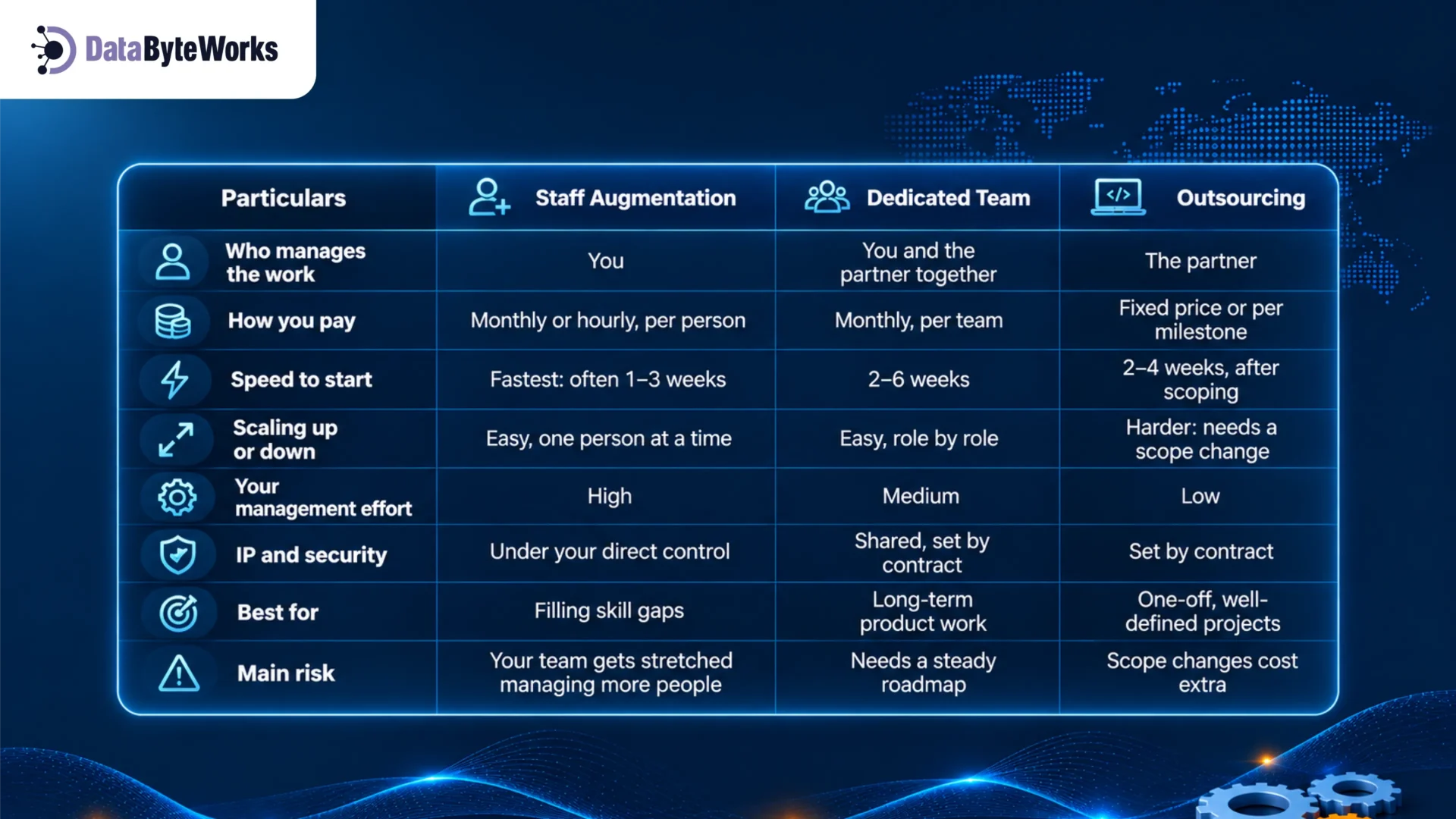
Side-by-Side Comparison
What is Staff Augmentation?
Staff augmentation means adding outside developers to your existing team for as long as you need them. They join your stand-ups, use your tools, and follow your processes. The partner handles hiring, payroll, and HR. You decide what they work on each day.
How Staff Augmentation Services Work
Good staff augmentation services follow a simple path. You share the skills you need, review a shortlist of developer profiles, interview your top picks, and onboard them into your team, often within a few weeks.
Offshore Staff Augmentation
Offshore staff augmentation brings in developers from regions such as India or Eastern Europe. Rates are lower than in the US, and a good partner sets working hours that overlap with yours for daily calls.
Example: Filling a Cloud Skills Gap
Say your team is moving to AWS, but nobody has set up infrastructure at scale before. Instead of spending months hiring, you can hire AWS developers or DevOps engineers for six months. They build the setup alongside your team, and your engineers learn as they go.
Pros: fast to start, full control, flexible, and you only pay for the skills you need.
Cons: your managers carry the extra load, and knowledge can leave when the contract ends unless you plan a handover.
What is a Dedicated Development Team?
A dedicated development team is a full, stable team that works only on your product, usually for a year or more. Unlike staff augmentation, you don’t add people one by one. You get a complete unit, and the partner helps run it day to day.
How a Dedicated Developers Team is Set Up
A typical dedicated developers team includes a project manager or tech lead, developers, a QA engineer, and, where needed, a DevOps engineer. You set the goals and priorities. The team lead handles daily coordination, so your managers aren’t pulled into every detail.
Offshore Development Center Services
If you need a larger, long-term setup, offshore development center services take the idea further. An offshore development center (ODC) is your own team in the partner’s office, with its own space, tools, and processes. Some companies choose a “build-operate-transfer” option: the partner builds and runs the team, then hands it over to you as your own company later. Learn more about our offshore development center services.
A Real Example
A US logistics analytics company has worked with a DataByteWorks dedicated team of four developers and a tech lead for three years. In nine months, the team moved the company’s platform to .NET 10 and Azure while the old system kept running for live customers. Manual audit time dropped by 80%. A stable team made that possible, because the people who knew the system stayed on it.
Pros: long-term focus, deep product knowledge, predictable monthly cost, and less management load than staff augmentation.
Cons: takes a few weeks to set up, and works best with a steady roadmap rather than short bursts of work.
What is Software Development Outsourcing?
Software development outsourcing means handing a whole project to a partner who plans it, builds it, and delivers it. You agree on what will be built, when, and for how much. The partner manages the team and the day-to-day work.
What Good Software Development Outsourcing Services Include
Strong software development outsourcing services start with a clear agreement on four things:
- Scope: exactly what will be built.
- Deliverables: what you’ll receive at each stage.
- Milestones: dates and payments tied to progress.
- Service levels (SLAs): response times, quality standards, and support after launch.
For example, a Calgary hotel furniture maker needed a CRM and quoting platform. The scope was clear, so DataByteWorks delivered it as a 15-month fixed-scope project with a team of four. Quote preparation time dropped from 1–2 days to about 30 minutes. Check our recently published Hotel Furniture CRM & Quotation Platform case study to learn more.
Pros: little management effort, a predictable budget, and one partner accountable for the result.
Cons: less day-to-day control, and changes to the scope usually mean extra time and cost.
Head-to-Head: How the Models Compare
Staff Augmentation vs Dedicated Team
The difference is who leads them. With staff augmentation, you lead every person yourself. With a dedicated team, the team comes with its own lead, so you set direction while the partner handles daily coordination. If your managers are already stretched, a dedicated team is usually the better choice.
Staff Augmentation vs Outsourcing
This is about control versus convenience. Staff augmentation keeps you in charge of every decision. Outsourcing hands the decisions, and the delivery risk, to the partner. Choose augmentation if your plans change often. Choose outsourcing if you know exactly what you need.
Dedicated Team vs Outsourcing
The question here is how long the work lasts. A dedicated team suits ongoing work, where knowledge builds up over time. Outsourcing suits a project with a clear finish line.
What It Really Costs
In the US, a mid-level contract software engineer costs about 96-122 an hour (median $108) in late 2026. Offshore developers in India typically cost 25-50 an hour for a similar level. That gap is why many US companies use offshore teams.
The hourly rate isn’t the whole story, though. Budget for these hidden costs too:
- Onboarding: new people need 2–6 weeks to learn your product.
- Management time: someone on your side still has to set priorities and review work.
- Turnover: if people leave, knowledge leaves with them. Ask partners how they handle replacements.
- Rework: a cheaper team that needs constant fixes can end up costing more than a strong one.
Which Model Fits Your Project?
Start with two simple questions:
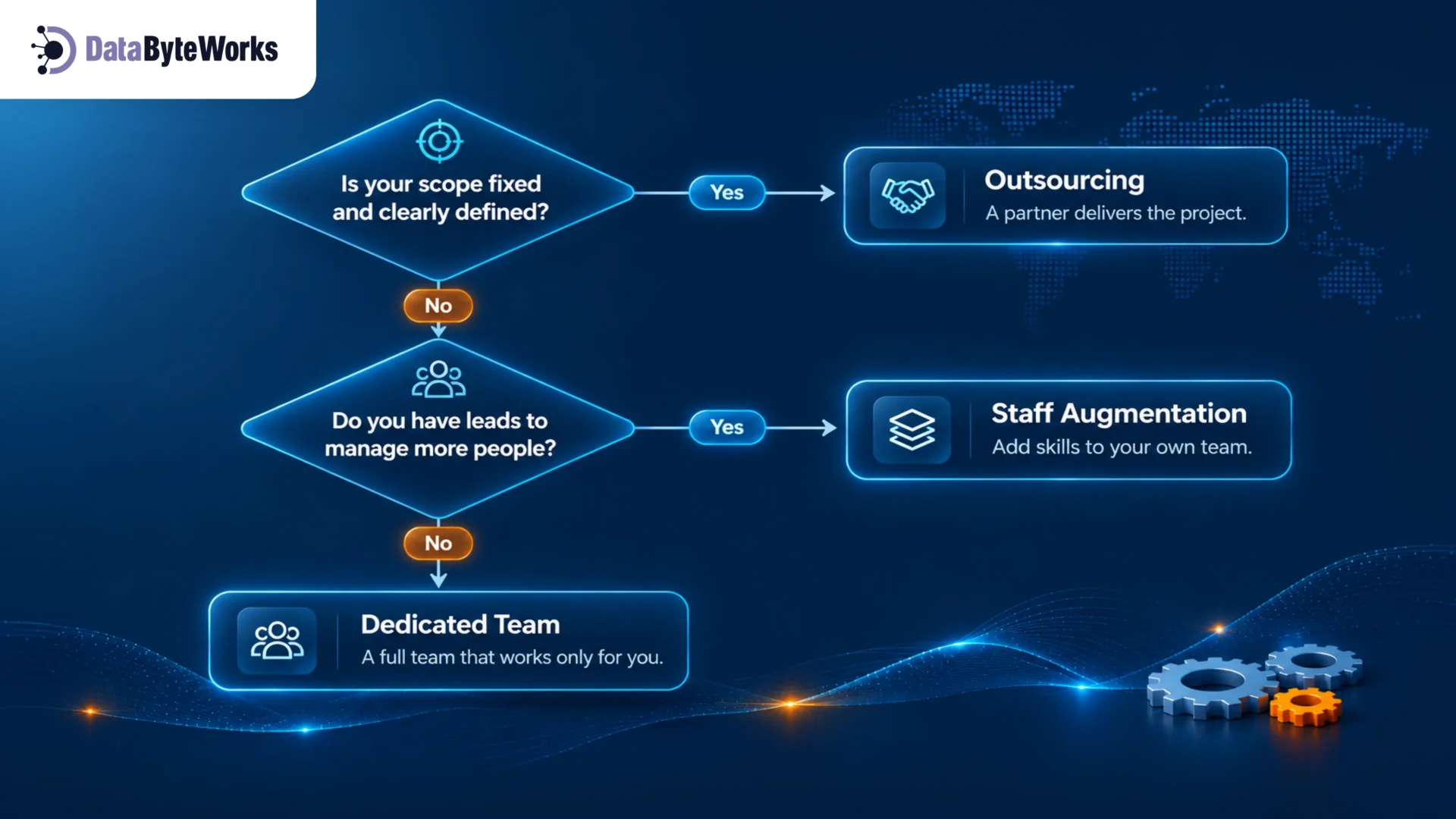
If your code or data is highly sensitive, lean toward staff augmentation or a dedicated team, so you keep more control.
Real-World Scenarios
- A seed or Series A founder building an MVP: A small dedicated team gives you a product team without the cost of building one in-house. If the scope is very clear, outsourcing can work too.
- A scaling startup with an engineering team: Use staff augmentation to add the skills you’re missing, such as mobile, DevOps, or data.
- An enterprise CTO modernizing or moving to the cloud: A dedicated team handles the long migration, and augmented specialists fill short-term gaps such as cloud security.
- A CEO with a fixed, one-off project: Outsourcing gives you one partner, one price, and one delivery date.
The Hybrid Approach
You don’t have to pick just one. Many companies run a dedicated team for their core product and bring in augmented specialists for short bursts of work, like a security review or a cloud migration. You keep knowledge in a stable team and still get flexibility when you need it.
What US Companies Should Check
- Time zones. Latin America (nearshore) shares most of your working day. Eastern Europe overlaps with the US East Coast in the morning. India is 9.5–13.5 hours ahead, so a good partner shifts hours to give you 2–4 shared hours a day. Ask for it in writing.
- Compliance and IP. If you handle health, payment, or personal data, make sure the partner can support SOC 2, HIPAA, or GDPR. The contract should clearly say that you own all code and IP.
- Contractor classification. With staff augmentation, the developers should stay employed by the partner, not by you. This lowers co-employment risk, where you could be treated as their legal employer. Check the setup with your lawyer.
- Offshore, nearshore, or onshore. Offshore costs the least, nearshore gives more overlap, and onshore gives full overlap at the highest price. Many companies mix them.
How to Choose a Partner
Before you sign, check:
- Technical skill: Interview the actual developers, ideally on a real task from your codebase.
- References: Speak to two or three US clients of a similar size.
- Communication: How often they report progress, and who your main contact is.
- Contracts: Clear IP ownership, confidentiality, and security terms.
- Exit terms: Notice periods, and how code and knowledge are handed over if you leave.
Red flags: Prices far below the market, no chance to interview the developers, vague IP terms, and a partner who agrees to everything without asking questions.
Getting Started in 30 to 90 Days
Start small. In month one, share your goals and give the team a low-risk task. In month two, move to real work with weekly reviews. In month three, check the results and decide whether to scale up.
From day one, track three things: how much work gets done, how many bugs come back, and whether the same people stay on your project.
Find the Model that Moves Your Project Forward
There’s no single right answer in the staff augmentation vs dedicated team vs outsourcing debate. There’s only the right fit for your project. If you have strong leaders and need skills fast, augment your team. If you’re building for the long term, invest in a dedicated team or an offshore development center. If you know exactly what you need, outsource it.
Whichever path you choose, the goal is the same: ship faster without losing control.
DataByteWorks helps US companies with all three models, from hiring AWS developers for a cloud project to building a full offshore development center.
Book a free consultation, or request developer profiles, through our staff augmentation services team.