

When people think of AI in healthcare, they often picture robots in surgery or AI reading scans. But for most clinics and hospitals, the quickest wins sit in the back office: forms, insurance checks, phone calls, and follow-ups.
This work keeps growing. In MGMA’s 2026 prior authorization brief, 90% of medical practices said their prior authorization workload rose in the past 12 months.
Back-office tasks follow clear rules and are repeated many times a day. That makes them the safest place to start healthcare automation. In this guide, you’ll learn which five tasks to automate first, what AI should never do, how to estimate savings, and how to test it in 90 days. For a closer look at one task, read which prior authorization tasks AI can take over, and which it can’t.
Why back-office work is where AI pays off first
Prior authorization burden keeps rising
Prior authorization means getting a payer’s approval before a test, drug, or procedure. It is slow and getting slower. In a September 2026 MGMA poll, 44% of practices said approvals took longer in 2026 than in 2025. Only 7% said they got faster.
Every delay means a waiting patient and a staff member stuck on hold.
CMS deadlines start applying in 2026 and 2027
A new CMS rule (CMS-0057-F) forces payers to move faster and go digital:
| What changes | When |
| Payers must decide urgent requests within 72 hours and standard requests within 7 calendar days | 2026 |
| Payers must offer digital prior authorization and data-sharing APIs | January 1, 2027 |
The rule covers Medicare Advantage, Medicaid, and CHIP plans, and (for the APIs) plans on federal exchanges. Payers will speed up. If your team still faxes forms and tracks requests in spreadsheets, your side becomes the bottleneck.
Five healthcare operations tasks to automate first
Task 1: Prior authorization requests
- AI can: Fill payer forms using chart data, check if a service needs approval, and track each request’s status.
- Deadlines to plan for: See the CMS timelines in the table above. Payers must answer urgent requests in 72 hours and standard ones in 7 days. Complete, fast submissions help you benefit.
- A person still decides medical necessity and handles peer-to-peer reviews.
Read more: Which prior authorization tasks AI can take over, and which it can’t.
Task 2: Insurance eligibility and patient intake
Insurance problems missed at check-in often become denied claims weeks later.
- Check coverage early: run automatic eligibility checks 2–3 days before the visit and flag problems.
- Smarter intake: patients fill in digital forms, and AI reads insurance cards and IDs into the right fields.
- Consistent records: match patient details across scheduling, EHR and billing, so one typo doesn’t spread.
Task 3: Claims coding and denial management
- Find denial patterns: group denials by payer, code, and reason, then fix the root cause.
- Draft appeals: AI writes a first draft from the dental code and notes. Staff review and sign it.
- Suggest codes: AI proposes billing codes. Certified coders confirm them.
Task 4: Clinical documentation support
This is the most visible AI use in healthcare for clinicians. Ambient AI scribes listen to the visit and draft the note, so doctors spend less time typing after hours.
- What they capture: the conversation, a structured note, and suggested orders for review.
- Where it’s heading: MarketScale reports that ambient AI is moving into consent and billing controls, because note quality affects coding and approvals.
- Check first: how patients consent (including telehealth), how long audio is stored, who can access it, and whether the vendor trains its AI on your data.
Task 5: Scheduling, reminders and follow-ups
- Reminders and recalls: send automatic text or voice reminders and recall patients due for checkups.
- Track loose ends: flag referrals with no booked visit and lab results with no follow-up.
- Route messages, don’t answer them: AI sorts patient messages to the right person. It never replies to clinical questions on its own.
Where AI helps, and where it must stop
Clear limits build trust with staff, patients, and compliance teams.
| Task | AI does the work | A person signs off | Never let AI |
| Prior authorization | Forms, checks, status tracking | Submissions and peer reviews | Decide medical necessity |
| Eligibility and intake | Coverage checks, data entry | Flagged coverage gaps | Turn away a patient |
| Claims and denials | Patterns, draft appeals, code suggestions | Final codes and appeals | Submit codes unchecked |
| Documentation | Draft visit notes | Every note before signing | Finalise a medical record |
| Scheduling | Reminders, tracking, routing | Clinical messages | Give medical advice |
How to choose the first task
The best first automation project is boring, frequent, and clearly defined. Score each task from 1 (low) to 5 (high):
| Question | What to measure | Score (1–5) |
| How often does it happen? | Requests, claims, or calls per week | |
| How much staff time does it take? | Hours per week across the team | |
| How costly are mistakes? | Denials, delays, rework, complaints |
Add up the scores and shortlist the top two. Then pick the one with the clearest rules. Tasks with fixed steps, like eligibility checks or reminders, are easier to measure and easier for staff to trust.
Estimate the savings before you start
Use this simple formula. The numbers below are an example only, so replace them with your own.
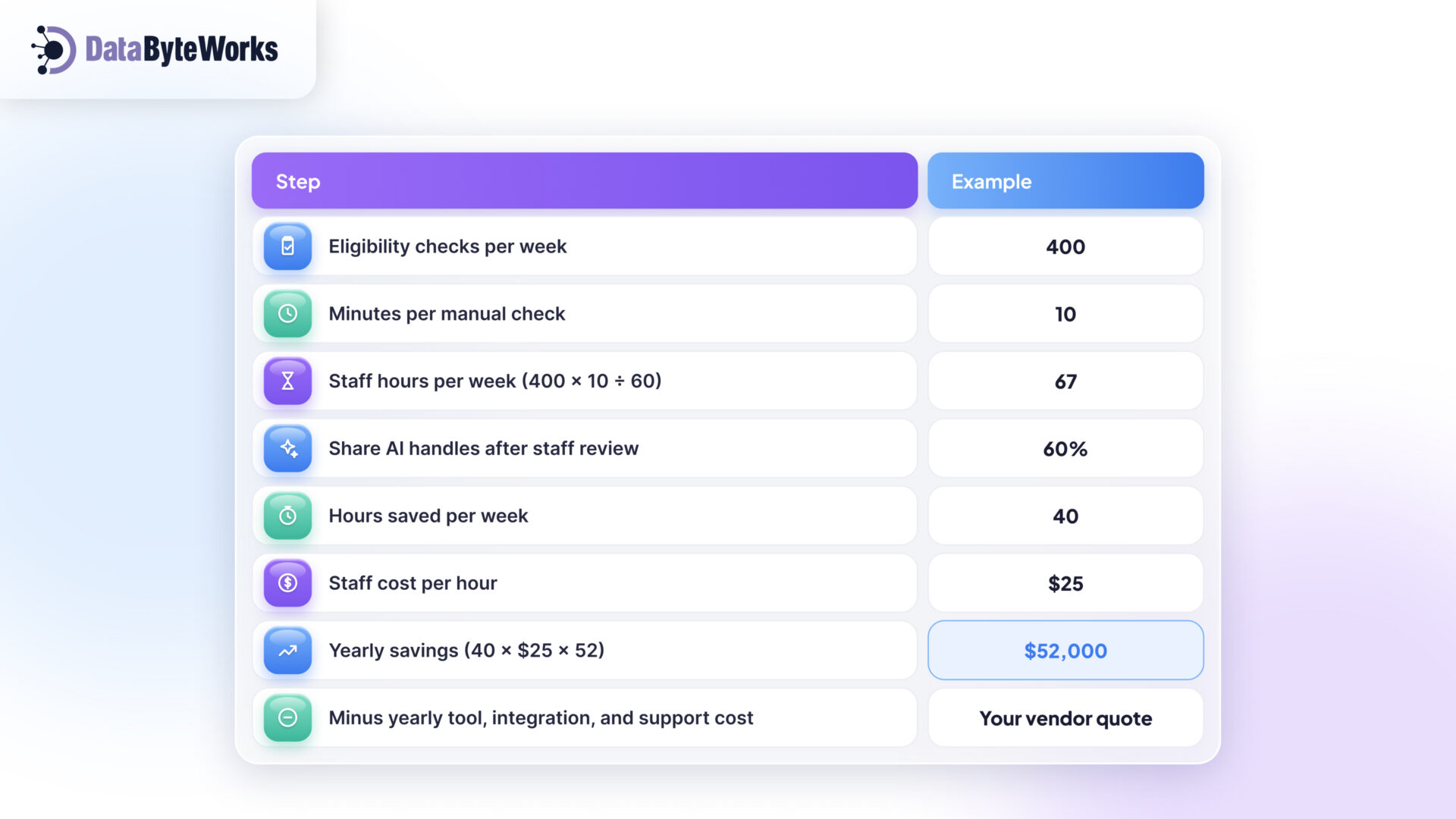
If the savings don’t clearly beat the cost, pick a different task. Also count benefits that are harder to price, like fewer denials and less overtime.
Where healthcare AI adoption usually stalls
Most pilots don’t fail because of the AI. They stall on the workaround for it. Plan for these three blockers:
- Data access and EHR integration: the tool needs clean data from your EHR, billing system, and payer portals. Confirm how it connects (APIs, FHIR, or HL7) before you sign.
- Staff trust and workflow changes: people trust tools they helped shape. Involve front-desk, billing, and clinical staff from week one.
- Compliance review and vendor agreements: sign a Business Associate Agreement (BAA), check where data is stored, and bring compliance in early.
Five questions to ask any AI vendor
- Will you sign a BAA?
- Do you train your AI on our patient data?
- How do you connect to our EHR, and who maintains it?
- Can we see an audit log of every AI action?
- What happens to our data if we stop using you?
A 90-day pilot plan
A short pilot proves value before you spend big. Split it into three four-week phases:
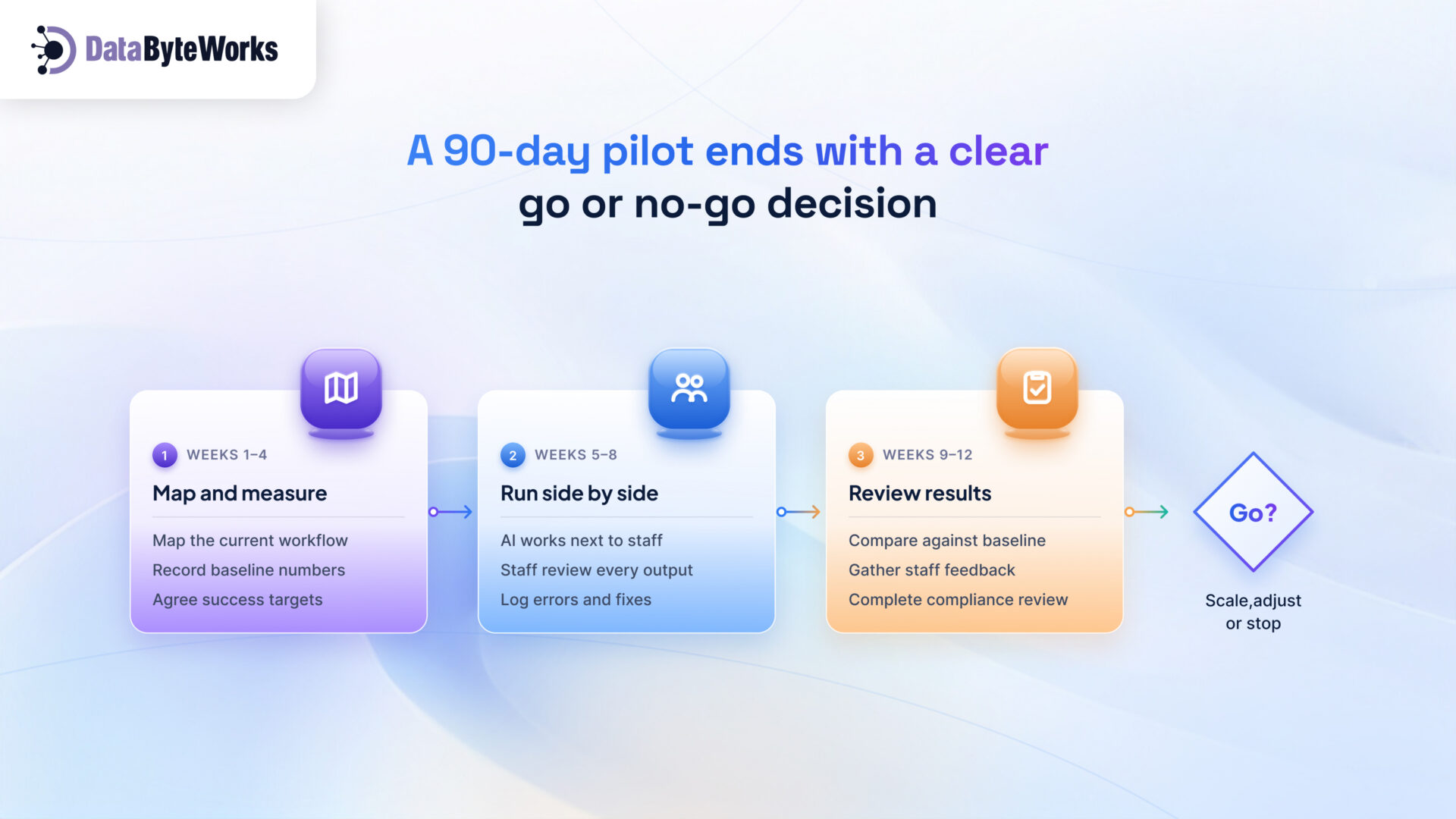
- Weeks 1–4: map each step of the task and record baseline numbers: hours spent, turnaround time, and error rate.
- Weeks 5–8: run the AI next to your staff. People check every output, so nothing reaches a payer or patient unreviewed.
- Weeks 9–12: compare the results with your baseline and decide.
Agree on the decision rules before the pilot starts, so the result isn’t a matter of opinion:
| Decision | When to choose it |
| Scale | You hit your targets, errors are at or below manual levels, and staff want to keep it |
| Adjust | You see real gains, but errors or integration gaps need fixing first |
| Stop | No clear gain after fixes, or compliance concerns you can’t resolve |
How DataByteWorks helps healthcare teams build automation
DataByteWorks builds automation around the systems you already use. Our healthcare software development team connects AI to your EHR, payer portals, and billing tools, with HIPAA-ready security from day one.
We start small with one task, clear baseline numbers, and a 90-day pilot. Then we grow into wider healthcare technology solutions for intake, claims, and scheduling. As an AI development company, we keep people in charge of every clinical decision.
Ready to pick your first task?
Book a free 30-minute workflow review. We’ll help you score your tasks, estimate savings, and plan a pilot your team can trust.
Talk to our team →