

Every founder dreams of 10,000 customers. Very few need to build for them on day one.
That’s the real challenge in Saas product development. Build too little, and growth forces a painful rewrite. Build too much, and you burn cash on systems for customers you don’t have yet.
This guide shows you how to strike the right balance: what to build at each stage, which decisions to make early, which to postpone, and the signs that it’s time to scale.
What Scalable Really Means for a Founder
Scalable doesn’t just mean “the servers can cope.” For a founder, it means three things:
- Technical: The product stays fast as customers and data grow.
- Operational: You don’t need a new hire for every few new customers.
- Financial: Each new customer costs less to serve than they pay you.
The last one gets ignored most often, and it hurts the most. CB Insights’ from their updated analysis of 431 failed VC-backed startups (published/updated around 2024–2026) found that 70% startups ran out of money, 43% lacked product-market fit, and 19% had unit economics that didn’t work.
The opportunity is huge for founders who get it right. According to data from Statista, worldwide SaaS revenue is projected to reach $488.5 billion in 2026. Fueled by enterprise AI adoption and cloud migrations, the global market is on track to cross $855.6 billion by 2031, maintaining a strong compound annual growth rate (CAGR) of 11.86%.
Grow in Stages, Not All at Once
The most common mistake in SaaS product development is building for stage three while you’re still in stage one. Each stage has a different job:
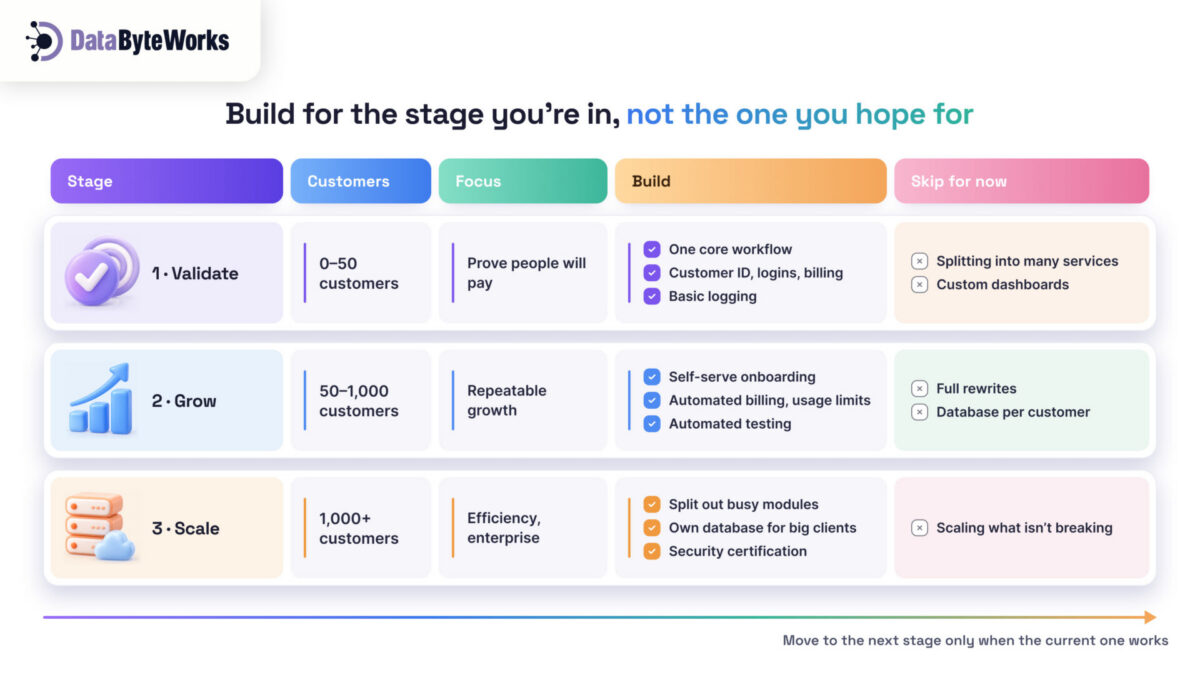
Move to the next stage only when the current one works. A product that scales beautifully but nobody wants is still a failure.
How to Build a Scalable SaaS Product: 6 Steps
1. Validate the Problem First
Talk to 20–30 potential customers before you write code. Ask what they use today and what the problem costs them. If ten of them won’t say “I’d pay for that,” keep researching.
2. Scope a Focused MVP
Good SaaS MVP development means building the one workflow customers will pay for, not a small version of everything. If a feature doesn’t help a new customer get value in week one, cut it for now.
3. Lay a Scale-Ready Foundation
Get the few hard-to-change decisions right (see the next section) and keep everything else simple. One well-organised application, rather than dozens of small services, will carry most SaaS products past their first thousand customers.
4. Launch and Measure
Release to a small group of paying customers. Track three numbers: how many reach their first success, how many come back, and what each one costs you to serve. Let these numbers decide what you build next.
5. Automate the Manual Work
Before you push for growth, automate sign-up, onboarding, billing, and invoicing. If ten new customers mean ten hours of manual setup, you’ve built a service, not a SaaS product.
6. Scale Only What’s Breaking
Don’t rebuild everything because it sounds impressive. Find the one part that’s struggling, such as a slow report or an overloaded database, and fix that. Then measure again.
SaaS Architecture Best Practices: Decide Now vs. Decide Later
Scalable software architecture isn’t about using every new tool. It’s about knowing which choices are expensive to undo. These SaaS architecture best practices matter most at the start:
| Decide now | Why it’s hard to change later |
| A customer ID on every record | Adding data separation later means changing every table |
| Logins and user roles | Changing them breaks every customer’s access |
| Billing and plan settings | Your pricing will change, so keep plans flexible, not hard-coded |
| A clean data structure | Reports and integrations all depend on it |
| Logs and monitoring | You can’t fix problems you can’t see |
| A record of key actions | Large clients and security audits will ask for it |
Safe to postpone until your data says you need them: Splitting into many small services, complex server setups, hosting in several regions, and formal security certifications.
A simple test: If changing it later means moving customer data or making customers change something, decide now. If it only affects your own servers, it can wait.
Choose How You’ll Separate Customer Data
One SaaS product serves many customers (“tenants”). How you keep their data apart is the most important early choice, because switching later is slow and risky.
| Model | How it works | Cost per customer | Data separation | Best for |
| Shared database | All customers share tables, each row tagged with a customer ID | Lowest | Good | Most new B2B SaaS products |
| Separate section per customer | One database, a separate area for each customer | Medium | Stronger | Customers with custom needs |
| Separate database per customer | Each customer gets their own database | Highest | Strongest | Banks, healthcare, large enterprises |
Most products start with a shared database and later move their largest or most regulated clients to their own database. That works well, as long as the customer ID is there from day one.
Signs It’s Time to Scale
Don’t scale on a hunch. Watch for these signs and fix the one that’s actually showing:
| Sign | What it usually means | What to do |
| Pages slow down at busy times | A few heavy database queries are the bottleneck | Speed up those queries or add caching |
| One big customer slows down everyone else | Shared resources are stretched | Set usage limits or give that customer their own resources |
| Onboarding takes hours per customer | Manual work is limiting growth | Automate setup, data imports, and billing |
| Releases keep breaking other features | The code is hard to change safely | Add automated tests, then separate the busiest part |
| Large prospects ask for security reports | You’re moving towards enterprise clients | Start security certification and tighten access controls |
Know Your Cost per Customer
This is the number most founders skip. Add up your monthly cloud bill, software tools, and support time, then divide by your number of customers.
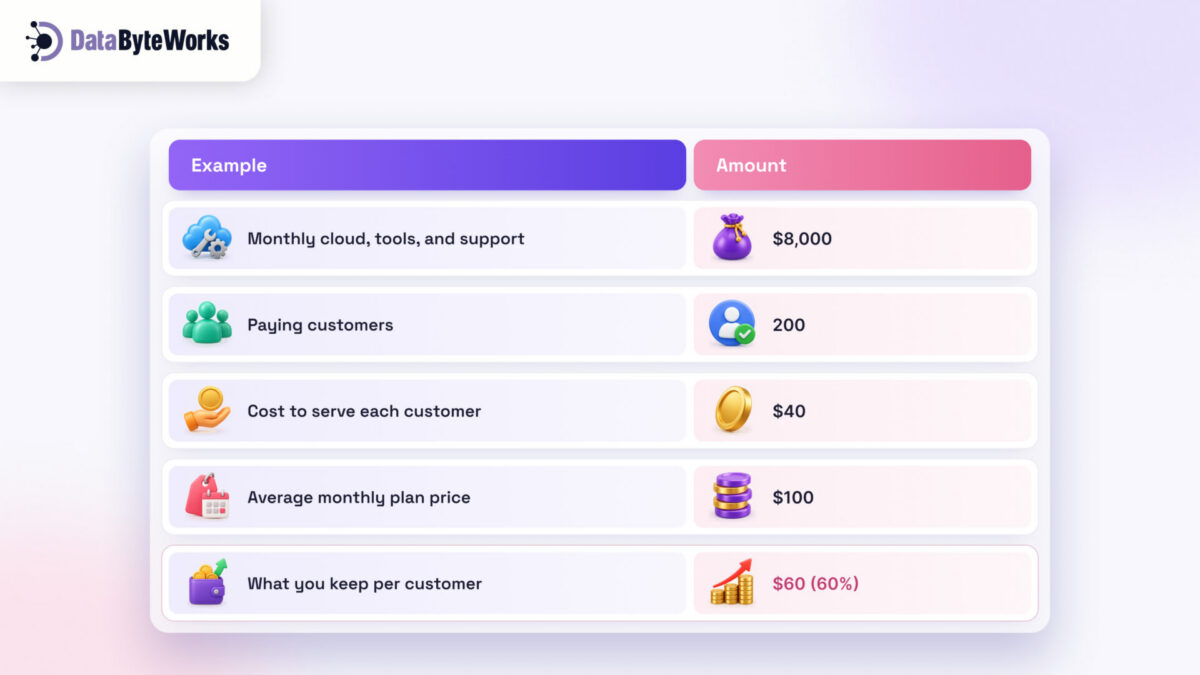
If this number rises as you grow, fix your pricing or architecture before chasing more customers.
Founder Mistakes That Make Scaling Painful
- Skipping the customer ID. It feels unnecessary with five customers. It’s a rewrite with five hundred.
- Hard-coding prices. Your first pricing will be wrong. Make plans easy to change.
- Copying big-tech setups. Netflix-style systems solve Netflix-sized problems you don’t have yet.
How DataByteWorks Helps Founders Build SaaS That Scales
We work with founders from the first idea to a growing customer base. Our SaaS product development and custom software development services team helps you:
- Validate and scope an MVP that your first customers will pay for
- Build a scale-ready foundation with the right data separation, logins, and billing from day one
- Launch on secure cloud infrastructure, mainly Azure and .NET, with Python for data and AI features
- Scale with evidence, fixing real bottlenecks and tracking cost per customer