

Data Governance Framework: A Practical Guide for Growth
Introduction
Imagine a scenario. It’s the weekly leadership meeting. Sales says last quarter’s revenue was ₹4.2 crore. Finance says ₹3.9 crore. Marketing’s dashboard shows a third number. The meeting turns into a debate about whose spreadsheet is right.
This happens in almost every growing business. Data sits in five different tools, and nobody owns it. A data governance framework fixes this. It gives each dataset an owner, one agreed definition, and a quality standard your team can trust.
This guide explains what a framework includes, when you need one, which standards to set first, and how to launch it in 90 days.
What Is a Data Governance Framework?
A data governance framework is a set of rules, roles, and processes. It decides who can access your data, who can change it, and how you know it’s correct.
It is more than an IT policy. It covers ownership, quality, security, and daily use together. Business teams own what the data means. IT enforces the controls.
People often mix up three related terms. Here’s how they differ:
| Term | What it does | Simple example |
| Data governance | Sets the rules and assigns responsibility | Finance owns the definition of “revenue” |
| Data management | Does the daily work of storing and moving data | Syncing CRM data to a warehouse every night |
| Data security | Protects data from leaks and attacks | Encryption, two-factor login, firewalls |
Why Growing Businesses Need Strong Data Governance
As you grow, your data grows faster than your discipline. Every new hire, tool, and integration adds risk. The warning signs are easy to spot:
- Duplicate records: one customer, three spellings.
- Conflicting reports: two dashboards, two answers.
- Slow decisions: leaders wait while analysts fix numbers by hand.
Spreadsheets and tribal knowledge work for a 15-person team. They break at 150. That’s when you need proper enterprise data management.
Waiting is expensive. Gartner estimates that poor data quality costs organizations at least $12.9 million a year on average. In a 2025 Precisely and Drexel LeBow survey, 64% of data professionals named data quality their top data challenge, and 51% named governance, up from 27% in 2023.
When should you start? Governance by growth stage
Most guides assume you’re a large enterprise. You aren’t, so match governance to your size:
| Stage | Warning signs | What to put in place |
| Early (under 50 people) | Data lives in 3–5 apps; one person “knows everything” | An owner for each key dataset; a shared glossary of your top 10–15 metrics |
| Scaling (50–250 people) | Reports conflict; CRM duplicates grow; first compliance questions | A governance lead, access tiers, and validation rules in your CRM |
| Established (250+ people) | Teams build their own dashboards; AI projects begin | A governance council, a data catalog, and automated quality monitoring |
Core Components of a Data Governance Framework
Every framework stands on four parts. Remove one, and the others get weaker.
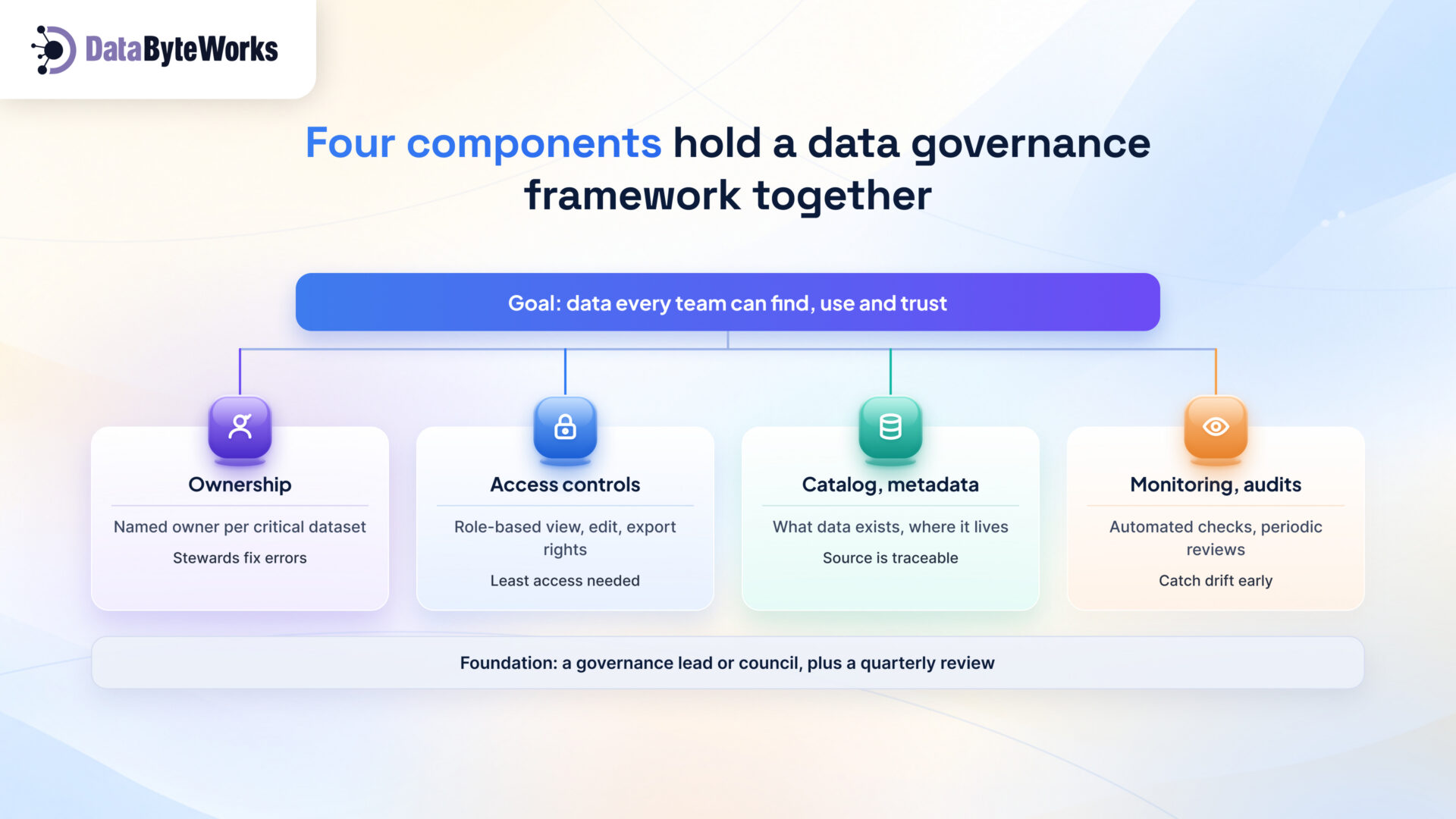
- Ownership and stewardship: each key dataset has a named owner, plus a steward who fixes issues day to day.
- Policies and access controls: people get access by role. A sales rep needs pipeline data, not payroll.
- Catalog and metadata: a simple list of what data exists, where it lives, and who owns it.
- Monitoring and auditing: automated checks and regular reviews catch errors and misuse early.
Who does what: roles in plain language
| Role | Usually who | What they do |
| Data owner | A business head, such as the Head of Sales | Approves definitions and access; accountable for the data |
| Data steward | A hands-on team member | Fixes errors, answers questions, keeps data clean |
| Data custodian | IT or the data engineering team | Runs systems, backups, and security controls |
| Data consumer | Anyone who uses reports | Uses data as defined and flags problems |
In a small team, one person can hold two roles. Just write it down so everyone knows.
Data Governance Standards to Put in Place
Standards turn good intentions into daily habits. Start with these three data governance standards.
1. Naming and classification
Give every key metric one name and one meaning. “Active customer” should mean the same thing in every report. Then sort your data by sensitivity:
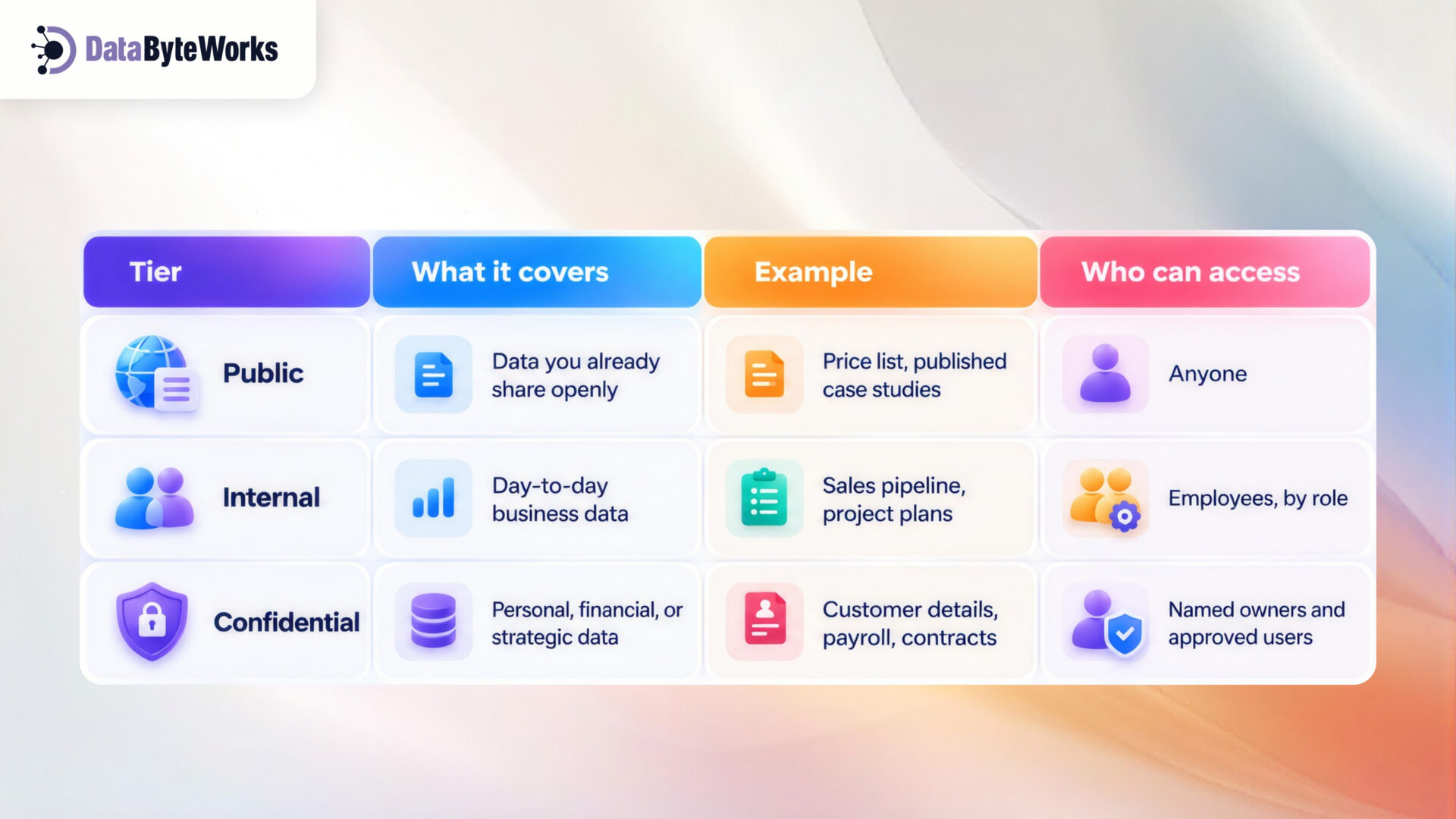
2. Compliance baselines
List the laws that apply to you. In India, the Digital Personal Data Protection (DPDP) Act governs personal data. Selling to Europe? Add GDPR. Taking card payments? Add PCI DSS. Then build these rules into your access and retention policies.
3. Data lineage
Record where each key field comes from and what changed it. When a number looks wrong, your team can trace it in minutes, not days.
Building a Data Quality Framework
Governance sets the rules. A data quality framework checks that your data follows them. Gartner reports that 59% of organizations don’t measure data quality at all. Simply measuring it puts you ahead of most.
Pick the quality dimensions that matter
| Dimension | The question it answers | Sample check |
| Accuracy | Is the value correct? | Match 50 customer addresses against invoices each month |
| Completeness | Are required fields filled? | Block CRM records without an email |
| Consistency | Do systems agree? | Compare monthly revenue in CRM and accounting |
| Timeliness | Is the data fresh enough? | Alert when a daily sync is 6+ hours late |
Choose two or three per dataset. You don’t need all four everywhere.
Stop bad data at the door
Quality teams follow the 1-10-100 rule: preventing an error at entry costs about 1 unit, fixing it later costs 10, and ignoring it until it hits a customer or decision costs 100. So build checks into forms and imports: required fields, dropdowns instead of free text, format checks, and duplicate alerts.
Give every metric an owner
A red dashboard fixes nothing by itself. Name one person to review each quality metric weekly and drive the fix.
Data Governance Best Practices for Day-to-Day Execution
These data governance best practices keep your framework simple and alive:
- Start with one dataset. Customer or revenue data usually gives the fastest win.
- Write a one-page charter. List owners, key definitions, and access rules on a single page. Pin it where people work.
- Name a governance lead. One person or a council of three to five, even part-time, keeps decisions moving.
- Review every quarter. New tools and regulations arrive often. Update your standards to match.
Common mistakes and what to do instead
| Mistake | Better approach |
| Buying a tool before naming owners | Define owners and rules first; add tools later |
| Rolling out company-wide on day one | Pilot one dataset, prove value, then expand |
| Treating governance as an IT project | Make business teams own their data |
| Writing a 40-page policy | Keep a one-page charter people actually read |
| Ignoring the AI tools staff already use | Set clear rules on what data can go into AI tools |
Turning Your Framework into a Data Governance Strategy
A framework is the structure: roles, rules, and standards. A data governance strategy is the plan that links that structure to business goals. Without a strategy, a framework becomes paperwork.
Tie each priority to an outcome your leaders already care about, and track it with a clear metric:
| Governance priority | Business outcome | Metric to track |
| One definition of revenue | Faster month-end reporting | Books closed 2 days sooner |
| Role-based access | Fewer compliance incidents | Zero unauthorized exports of confidential data |
| CRM entry validation | Cleaner customer data | Duplicate contacts below 2% |
Review progress monthly with the governance team and quarterly with leadership. Governance is ongoing work, not a one-time project.
From Governance to Data Analytics for Business and AI
Governance is what makes data analytics for business reliable. A dashboard built on duplicate records and mixed definitions gives confident but wrong answers.
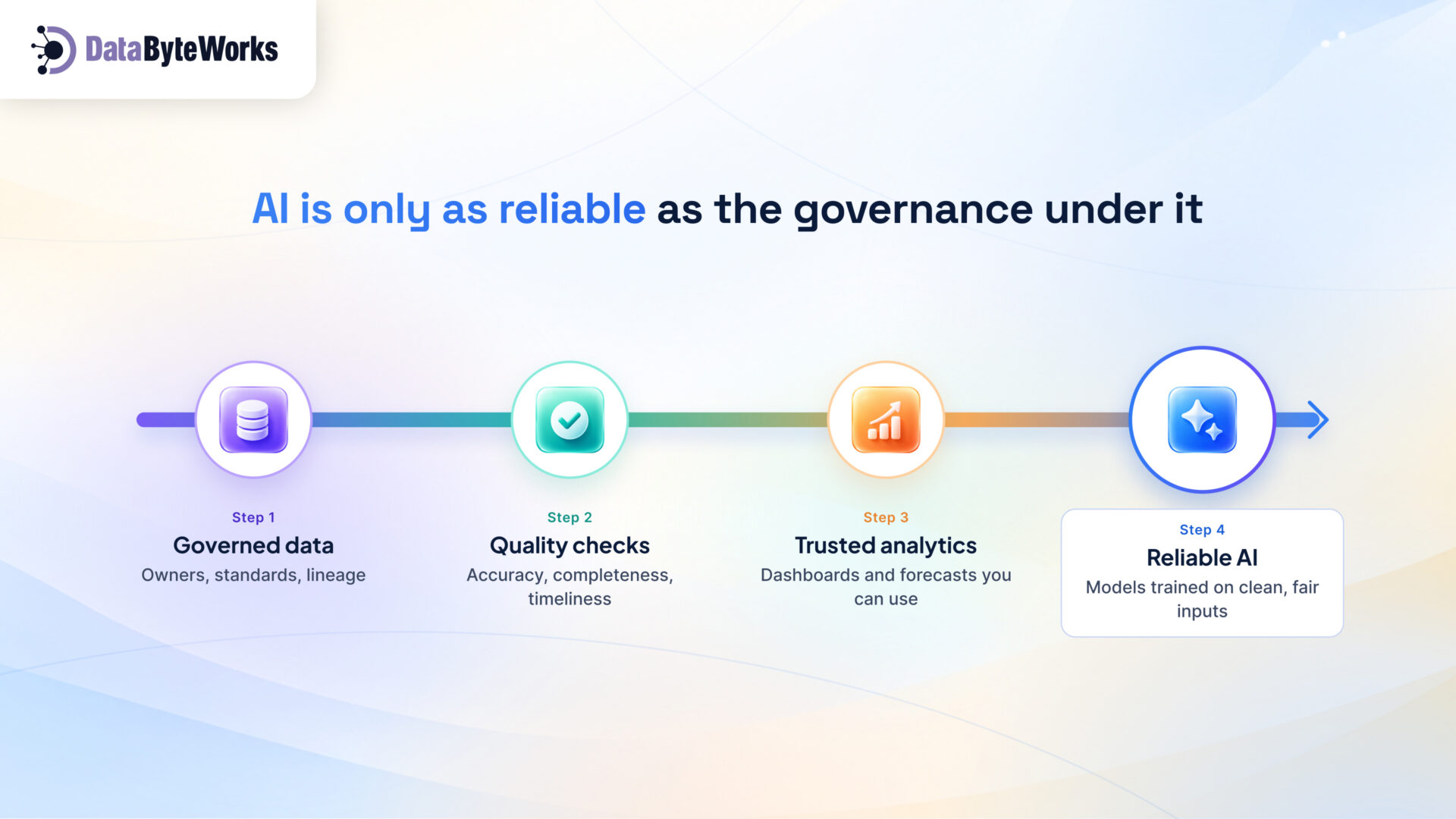
The stakes rise with data analytics AI. AI models learn from your data, so they copy its gaps and bias, then repeat them at scale. Gartner predicts that through 2026, organizations will abandon 60% of AI projects that lack AI-ready data. It also found that 63% of organizations lack, or aren’t sure they have, the right data practices for AI.
Two points most guides miss:
- Shadow AI is a governance gap. Staff may paste customer or financial data into public AI chatbots. Add one simple rule: which data tiers may go into which AI tools.
- Your governance plan is your AI readiness plan. Owners, lineage, and quality checks decide whether an AI pilot reaches production or stalls.
Getting Started: Implementation Checklist
You can launch a working framework in 90 days, in three phases.
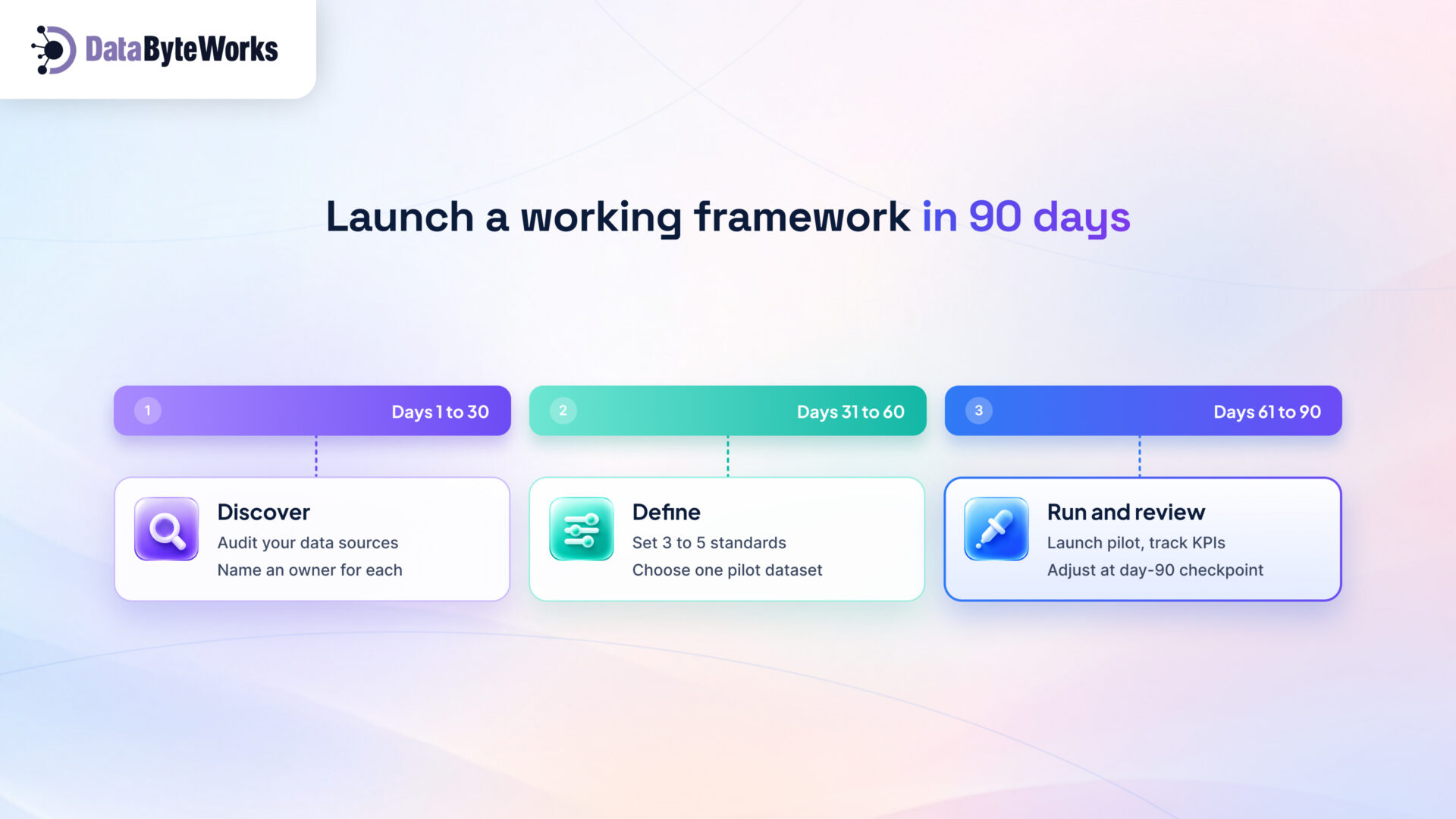
Use this checklist to stay on track:
- Audit your data sources and record who owns each one
- Define 3 to 5 governance standards to start with
- Name a governance lead or a small council
- Pick one pilot dataset or process to govern first
- Set a 90-day checkpoint to review results and adjust
Ready to build your data governance framework?
DataByteWorks helps growing businesses build governance that people actually follow, from the first data audit to AI-ready data. Book a free 30-minute consultation and leave with a clear first step for your team.