

Compliance Is the Foundation of Digital Trust
Healthcare and fintech companies handle some of the most sensitive information in the digital economy, from patient records and insurance details to card numbers and financial transactions. As these systems become more connected, healthcare data security and fintech security compliance are becoming business priorities, not just IT responsibilities.
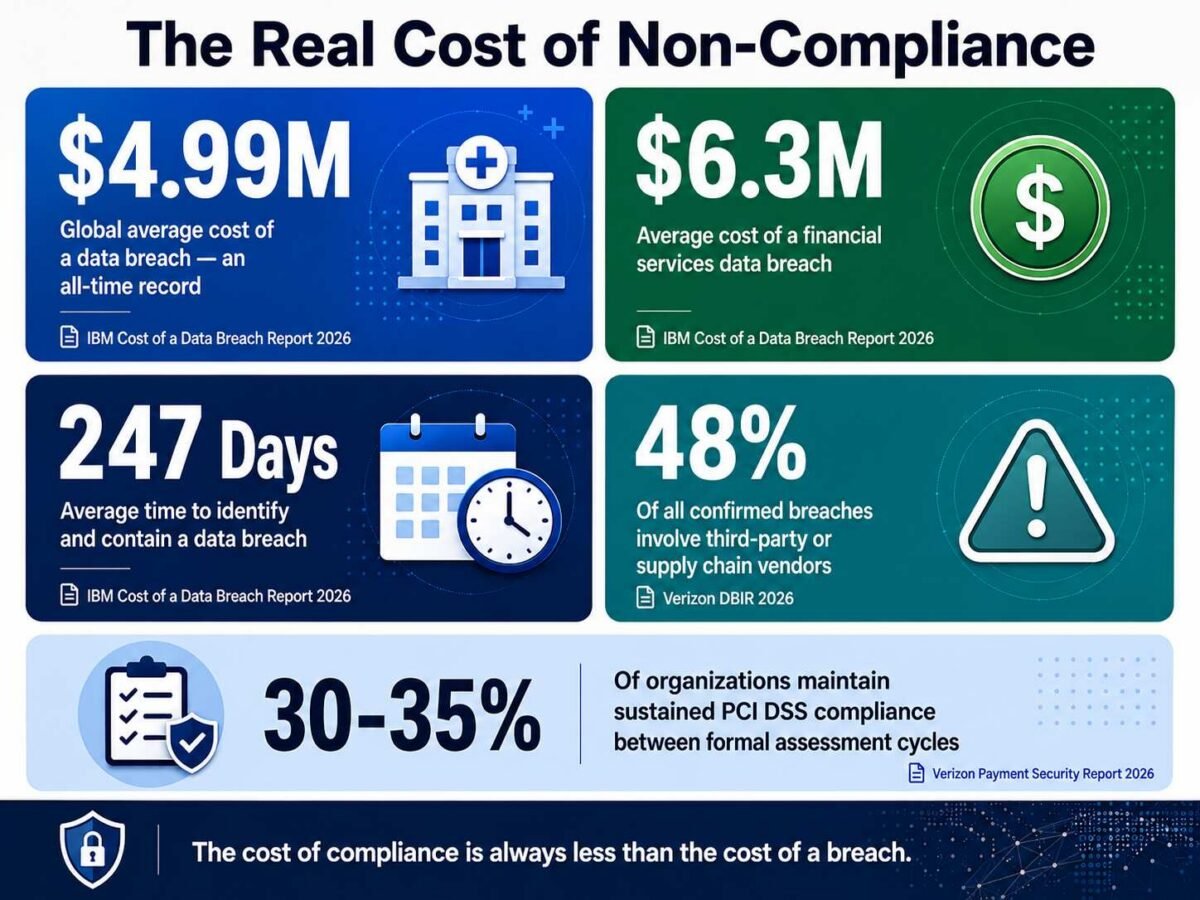
The financial impact is significant. As per IBM’s Cost of a Data Breach Report 2026, the global average cost of a data breach reached $4.99 million in 2026, while financial services breaches averaged about $6.3 million. IBM also found that the average breach took 247 days to identify and contain.
This guide explains HIPAA compliance and PCI DSS compliance, their key differences, overlapping controls, implementation steps, common mistakes, and a practical compliance checklist for healthcare, fintech, and healthcare fintech companies.
Understanding HIPAA and PCI DSS
HIPAA is a U.S. regulatory framework that protects PHI handled by covered entities and business associates. Its requirements include privacy protections, administrative and technical safeguards, physical safeguards, and breach notification obligations.
PCI DSS is a global payment security standard for organizations that store, process, or transmit payment card data. It aims to reduce cardholder-data exposure and strengthen payment security.
HIPAA vs PCI DSS: At a Glance
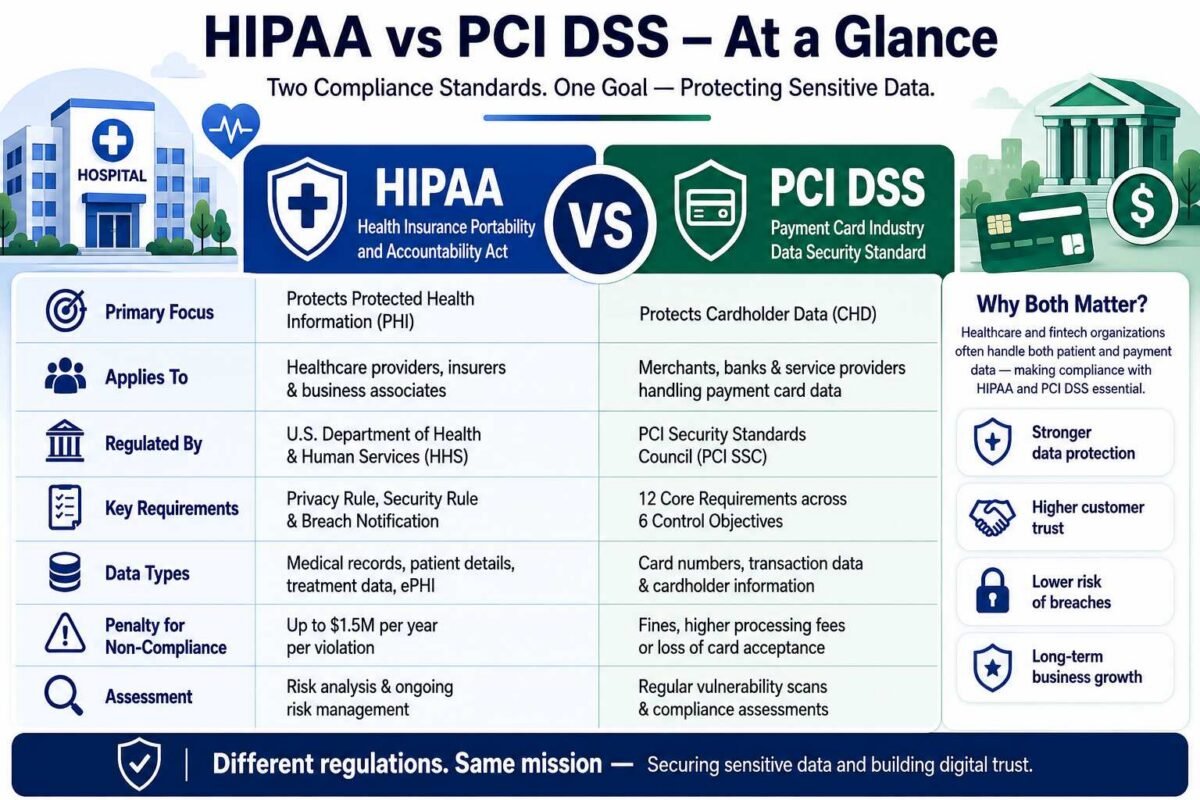
HIPAA vs PCI DSS is therefore not about choosing one framework over another. They address different types of sensitive information. A healthcare organization that accepts card payments may need to address both.
Understanding HIPAA requirements, PCI DSS requirements, and applicable payment security standards helps organizations build a security architecture that supports regulatory and contractual obligations.
Why Compliance Matters More Than Ever
Healthcare and fintech platforms have become attractive targets because the information they handle is valuable and their systems often need to remain continuously available.
According to the HHS Office for Civil Rights Breach Portal, The U.S. Department of Health and Human Services maintains a breach portal for reported breaches of unsecured PHI affecting 500 or more individuals. Current records include numerous hacking and IT incidents involving healthcare providers and business associates.
For fintech organizations, the attack surface extends across mobile apps, APIs, payment gateways, cloud environments, authentication systems, and third-party services. A weakness in any one component can expose sensitive information.
Compliance therefore supports more than regulatory readiness. Strong cybersecurity healthcare fintech practices can reduce exposure, improve operational resilience, strengthen customer confidence, and make vendor and enterprise partnerships easier to establish.
The Overlap Between HIPAA and PCI DSS
Although HIPAA and PCI DSS have different purposes, many of their security practices overlap:
- Data encryption
- Identity and access management
- Least-privilege access
- Network security
- Vulnerability management
- Security monitoring
- Logging and auditing
- Incident response
- Third-party risk management
- Employee security awareness
This overlap creates an opportunity to develop shared security controls instead of maintaining completely separate processes.
For example, centralized identity management can support access requirements across both healthcare and payment environments, while centralized logging can improve visibility across applications and infrastructure.
Step-by-Step Approach to Achieving Compliance
1. Start With a Comprehensive Risk Assessment
Begin by identifying what sensitive data the organization collects, where it is stored, how it moves, and who can access it. Map PHI, cardholder data, APIs, databases, cloud services, endpoints, and third-party integrations.
Document vulnerabilities and prioritize remediation based on business impact. This provides the foundation for both a compliance checklist healthcare teams can use and a broader enterprise security program.
2. Encrypt Sensitive Data Everywhere
Protect sensitive information at rest and in transit using strong, appropriately managed cryptographic controls.
Healthcare platforms should protect PHI across databases, backups, APIs, and connected applications. Fintech platforms can additionally use tokenization to reduce the exposure of payment card information.
Encryption alone does not create compliance. Key management, access controls, secure configurations, and monitoring must support it.
3. Implement Strict Access Controls
Use role-based access control, MFA, least privilege, and strong authentication policies. Users should receive only the access required for their responsibilities.
Privileged accounts deserve additional protection because they can provide broad access to sensitive systems.
4. Secure Networks and Infrastructure
Firewalls, secure configurations, segmentation, endpoint protection, vulnerability management, and intrusion detection help establish a stronger security foundation.
For payment environments, network segmentation can separate systems that handle cardholder data from unrelated infrastructure. This can help reduce unnecessary exposure and simplify scope management.
5. Monitor Systems Continuously
Compliance is an ongoing process. Organizations need centralized logging, security alerts, access monitoring, and incident detection across critical systems.
IBM’s 2026 research found that the average breach lifecycle reached 247 days, making timely detection and response particularly important.
6. Train Employees and Build Awareness
Employees interact with sensitive systems every day. Regular security training should cover phishing, password security, MFA, data handling, social engineering, and incident reporting.
Training should also evolve as new technologies and attack methods emerge.
7. Manage Third-Party Risks
Vendors, cloud providers, payment processors, SaaS platforms, and APIs can introduce additional exposure. Perform vendor assessments, review security documentation, define contractual responsibilities, and monitor critical providers.
Verizon’s 2026 DBIR reports that third-party involvement increased 60% year over year and reached 48% of breaches.
8. Develop a Strong Incident Response Plan
Define who responds to an incident, how teams contain systems, how they preserve evidence, and how they notify affected stakeholders.
Run tabletop exercises and technical response tests so teams understand their responsibilities before an actual incident occurs.
Common Challenges in Compliance
Healthcare and fintech organizations often operate across legacy applications, cloud infrastructure, APIs, mobile platforms, and multiple vendors. Maintaining consistent controls across this environment can be difficult.
Why Healthcare Fintech Companies Face Unique Compliance Challenges
Healthcare fintech platforms may process PHI, insurance information, payment card data, financial transactions, and personal information within the same ecosystem.
That creates overlapping responsibilities for data protection healthcare organizations need and the payment security controls fintech platforms require.
Common Compliance Barriers
1. Legacy infrastructure:
Older systems may lack modern authentication, encryption, logging, or integration capabilities.
2. Limited expertise:
Smaller organizations may not have dedicated compliance and cybersecurity specialists.
3. Third-party exposure:
External vendors and APIs introduce additional systems that require security reviews.
4. Changing environments:
Cloud migrations, new applications, AI tools, and integrations can change the compliance scope.
5. Cost pressures:
Compliance requires investment in technology, testing, monitoring, documentation, and expertise.
HIPAA & PCI DSS Compliance Checklist
Use this practical checklist to identify important areas for review:
| Control Area | Healthcare | Fintech |
| Data inventory | ✓ | ✓ |
| Risk assessment | ✓ | ✓ |
| Encryption | ✓ | ✓ |
| MFA | ✓ | ✓ |
| Least-privilege access | ✓ | ✓ |
| Network security | ✓ | ✓ |
| Vulnerability management | ✓ | ✓ |
| Logging and monitoring | ✓ | ✓ |
| Incident response | ✓ | ✓ |
| Employee training | ✓ | ✓ |
| Vendor assessments | ✓ | ✓ |
| Regular security testing | ✓ | ✓ |
| Data retention controls | ✓ | ✓ |
Healthcare organizations should additionally identify PHI flows, review business associates, maintain appropriate policies, and evaluate safeguards around electronic PHI.
Fintech organizations should identify cardholder-data flows, minimize unnecessary storage, segment payment environments, assess payment providers, and validate applicable PCI DSS controls.
Common Mistakes to Avoid
1. Treating Compliance as a One-Time Audit:
Passing an assessment does not mean security controls can be ignored afterward. Continuous monitoring and remediation are essential.
2. Relying Only on Encryption:
Encryption protects data, but it cannot replace authentication, authorization, monitoring, vulnerability management, or incident response.
3. Ignoring Third-Party Access:
A trusted vendor can still create security exposure. Limit, monitor, and periodically review vendor access.
4. Storing Unnecessary Sensitive Data:
Keeping information that the business no longer needs increases the potential impact of a security incident. Apply appropriate retention and deletion policies.
5. Adding Compliance at the End of Development:
Security and compliance requirements should be considered during architecture, development, testing, deployment, and maintenance, not immediately before an assessment.
Best Practices for Sustainable Compliance
Make security part of everyday operations. Establish clear ownership for compliance controls and review them regularly.
Automate security monitoring, vulnerability management, access reviews, reporting, and evidence collection where practical. Maintain current documentation so teams can demonstrate how controls operate.
A Zero Trust approach can further strengthen security by continuously evaluating identity, device posture, access context, and resource permissions.
For healthcare organizations, this creates stronger healthcare data security. For fintech businesses, it supports scalable fintech security compliance without making security an obstacle to product growth.
The Future of Compliance
AI, cloud computing, APIs, and connected platforms are changing compliance requirements and security risks.
AI can improve threat detection, security automation, and anomaly analysis, but organizations must also control how employees and applications access sensitive information.
Cloud adoption makes shared-responsibility models increasingly important. Organizations remain responsible for correctly configuring their applications, identities, data, and security controls.
The future of compliance will therefore depend on continuous visibility, automation, identity security, strong governance, and faster response.