

Gartner predicts that by the end of 2026, 40% of enterprise applications will include task-specific AI agents, up from less than 5% in 2025.
At the same time, Gartner expects more than 40% of agentic AI projects could be canceled by 2027 because of unclear business value, rising costs, and weak governance.
These numbers highlight the real opportunity and challenge around agentic AI in enterprise workflows. Enterprise AI agents are moving beyond simple chatbots and starting to plan, make decisions, use business systems, and complete tasks.
This guide explains what is agentic AI, how it differs from traditional automation and generative AI, where enterprises are using it today, and how to implement agentic AI without creating unnecessary risk or cost.
What Is Agentic AI?
What is agentic AI? Simply put, it is AI that can work toward a goal instead of only responding to a prompt.
A traditional chatbot receives a question and generates an answer. An AI agent can receive a goal, break it into smaller tasks, use tools or APIs, review the results, and continue until it completes the task.
For example, a chatbot can tell a customer that an order is delayed. An enterprise AI agent can check the order system, identify the delay, contact the logistics platform, update the customer, and create an escalation if it can’t resolve the issue.
This makes agentic AI useful for workflows that are too complex or unpredictable for fixed automation.
Agentic AI vs. Generative AI vs. RPA
These technologies often appear together, but they solve different problems. Understanding agentic AI vs generative AI and AI agents vs RPA helps businesses choose the right approach.
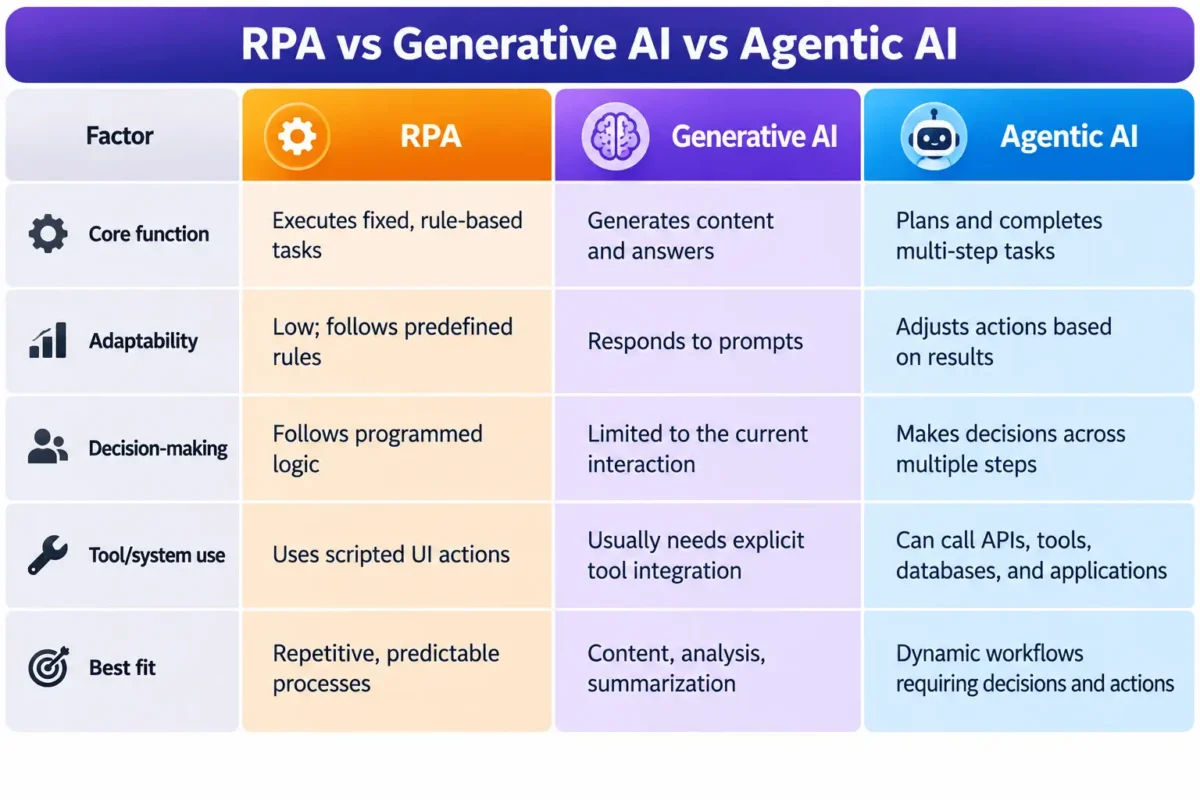
The simple difference is this: RPA follows instructions, generative AI creates outputs, and agentic AI works toward outcomes.
RPA remains useful for stable processes, while generative AI is valuable for knowledge and content tasks. Enterprise AI agents add another layer by combining reasoning, tool use, and action.
Why Enterprises Are Adopting Agentic AI Now
Three major changes are accelerating adoption.
First, foundation models are becoming better at reasoning, planning, and using tools. Second, enterprise software platforms are adding built-in agent capabilities, making adoption easier. Third, businesses are under pressure to improve productivity without continuously increasing operational costs.
The shift is already visible in enterprise adoption. A 2025 Google Cloud Study of 3,466 senior leaders across 24 countries found that 52% said their organizations were actively using AI agents, while 39% said their companies had launched more than 10 agents.
But adoption does not automatically create value. Businesses still need reliable data, clear processes, secure integrations, and measurable goals.
Another important signal comes from McKinsey’s 2025 State of AI research: 23% of respondents said their organizations were scaling an agentic AI system in at least one business function, while another 39% were experimenting with AI agents.
This shows where the market stands today: interest is high, but enterprise-scale adoption is still developing.
Real Enterprise Workflows Being Transformed
Customer Support & Service
Customer service is one of the most practical areas for autonomous AI agents for business.
Agents can classify incoming tickets, retrieve customer and order information, identify common problems, provide solutions, update records, and escalate complex cases to human representatives.
Instead of helping an employee complete one step, the agent can coordinate several steps across CRM, ticketing, knowledge-base, and order-management systems.
Finance & Reporting
Finance teams deal with large amounts of structured data and repetitive processes, making them strong candidates for agentic AI.
Enterprise AI agents can collect information from multiple systems, reconcile transactions, identify unusual entries, prepare draft reports, and route exceptions for human review.
An analyst can then focus on reviewing results and making decisions instead of manually collecting and organizing data.
Supply Chain & Logistics
Supply chains constantly change because of inventory levels, supplier delays, transportation issues, and changing demand.
Agentic AI can monitor these signals and take predefined actions when conditions change. For example, an agent could identify a stock shortage, check supplier availability, recommend alternatives, and initiate a reorder according to approved business rules.
This moves automation from simply identifying a problem to helping resolve it.
HR & Recruiting
Recruiting involves many repetitive coordination tasks that can consume valuable HR time.
AI agents can screen applications against defined requirements, schedule interviews, coordinate calendars, answer common candidate questions, and update applicant tracking systems.
Recruiters remain responsible for important decisions such as candidate evaluation, interviews, compensation discussions, and hiring decisions.
Healthcare Operations
Healthcare organizations are exploring agentic AI for administrative workflows where multiple systems and repetitive tasks create delays.
Potential applications include appointment scheduling, patient follow-ups, prior authorization, claims processing, and administrative coordination.
Because healthcare involves sensitive information and high-impact decisions, enterprise AI agents in this environment require stronger access controls, monitoring, human oversight, and compliance measures.
Key Benefits & ROI Considerations
The biggest advantage of agentic AI is not simply generating faster answers. It is connecting multiple steps into one workflow.
An agent can retrieve information, make a decision within defined boundaries, call another system, complete an action, and report the result. This can reduce manual work and let employees focus on tasks that require experience and judgment.
The business case can also be measurable. A Capgemini Research Institute study reports that organizations using AI across business operations are achieving an average ROI of 1.7x, with reported cost savings of 26%–31% across areas such as supply chain, finance, and customer and people operations.
However, ROI depends on the workflow, implementation quality, data, integration complexity, and level of human oversight.
The real question is not whether agents can perform tasks. It is whether they can perform the right tasks reliably enough to create measurable business value.
Risks, Governance & Responsible Deployment
The more freedom an AI system has to act, the greater its risk.
An agent connected to a CRM, ERP, payment platform, HR system, or healthcare application can make changes instead of simply recommending them. A wrong decision can therefore create financial, operational, privacy, or compliance problems.
This makes governance a core part of Agentic AI services, not an optional addition.
Businesses should establish role-based permissions that determine exactly what an agent can access. High-impact actions should have approval thresholds that require human review. Organizations should also maintain detailed logs showing what an agent did, which systems it accessed, and why it took an action.
Data quality is equally important. An agent cannot consistently produce reliable outcomes when the enterprise data it depends on is incomplete, outdated, or inconsistent.
Responsible deployment means balancing autonomy with control. Agents should have enough freedom to deliver value but enough boundaries to prevent unacceptable actions.
How to Get Started: A Practical Roadmap
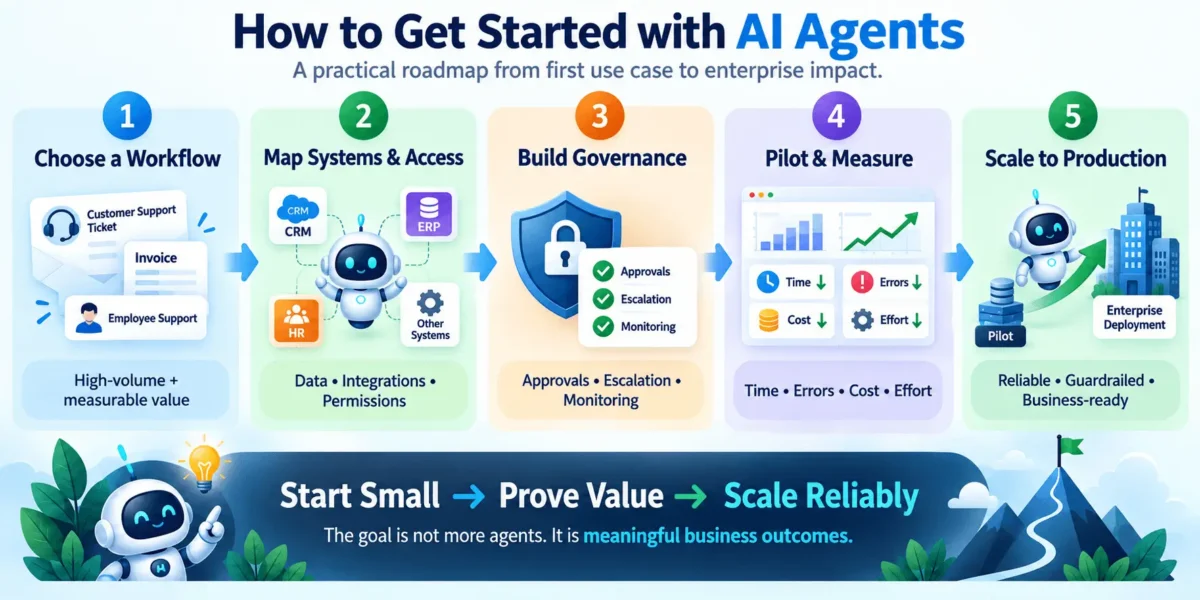
Start small. Instead of automating an entire department, choose one high-volume workflow with clear inputs, outputs, and measurable business value. For example, begin with a specific customer-service request, invoice reconciliation process, or employee-support workflow.
Next, map every system involved and determine what information and permissions the agent needs. This helps uncover integration and security requirements before development begins.
Then establish governance before deployment. Define user permissions, approval points, escalation rules, monitoring requirements, and audit logs from the beginning.
Finally, measure the pilot against clear business metrics such as processing time, resolution rate, manual effort, error rate, or operating cost.
Organizations without the required internal expertise can also work with an AI agent development company to design the architecture, connect enterprise systems, build guardrails, and move the solution from proof of concept to production.
The goal is not to deploy the most agents. It is to deploy agents that reliably solve meaningful business problems.