We Help You Embrace Agility
We help product and engineering teams develop an agile mindset through collaboration, continuous improvement, rapid learning, and outcome-focused agile development.
Agile Mindset
Teams embrace change, learn from feedback, and continuously refine their approach to respond faster, improve collaboration, and deliver greater value as priorities and customer needs evolve.
01
Turn insights into action
02
Confident decisions and accountability
03
Focused on meaningful results
How Agile Moves Forward
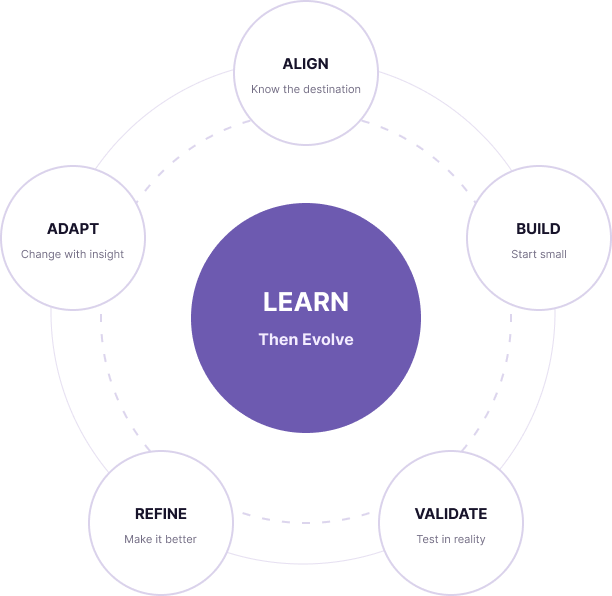
Agile turns uncertainty into a continuous path forward. Teams align on what matters, test ideas early, learn from real-world feedback, and improve with every cycle—without losing sight of the bigger business goal.
Define the desired outcome before deciding what to build. Align technology decisions with business priorities, customer needs, and measurable outcomes.
Agile Culture
Agility grows through everyday behaviors, not ceremonies alone. These principles help teams collaborate openly, learn continuously, and stay focused on meaningful progress.
Create space for honest ideas, healthy debate, diverse perspectives, and open dialogue, allowing teams to question assumptions, challenge decisions, and contribute confidently toward better outcomes.
Keep priorities, progress, key decisions, dependencies, and blockers clearly visible across teams, creating shared context that encourages transparency, faster collaboration, and stronger accountability.
Turn every cycle into a deliberate opportunity to simplify processes, strengthen solutions, learn from results, remove friction, and continuously improve how teams deliver meaningful value.
Treat setbacks as valuable learning opportunities, encouraging teams to share feedback openly, understand what happened, apply insights, and improve future decisions without fear of blame.
Give teams the context, trust, clarity, and autonomy they need to make confident decisions, take ownership, solve problems, and deliver meaningful outcomes independently.
Focus time, energy, and resources on work that creates meaningful customer and business value, while reducing unnecessary effort, prioritizing impact, and keeping teams aligned.
Use new insights, evidence, and feedback to refine priorities, strengthen decisions, respond thoughtfully to changing needs, and keep progress moving toward meaningful outcomes.
Make progress visible, learn earlier, remove friction, and adapt faster. Use continuous feedback and shared insights to identify emerging challenges, make timely decisions, and act before small problems become expensive, complex ones.
Agility in Action
Delivery System
Our agile delivery rhythm keeps teams focused, decisions visible, and progress moving without adding unnecessary process.
Clarify the desired outcome of your business, business priorities, key constraints, user needs, and measurable indicators of success before development begins.
Built for Distributed Teams
Business Impact
With DataByteWorks, agile becomes more than a delivery method. It helps teams decide faster, improve visibility, and turn continuous learning into measurable progress.
Faster Decisions
Shorter feedback loops help teams move from insight to action with greater confidence.
Clearer Progress
Visible priorities and ownership make progress easier to track across every cycle.
Stronger Alignment
Shared goals connect product, engineering, and business teams around meaningful outcomes.

Discover a people-first culture where collaboration, ownership, open communication, and continuous learning help our teams grow and create meaningful impact.
Our values guide how we think, collaborate, innovate, and deliver, and define who we are and how we work every day.
Discover a people-first culture where collaboration, ownership, open communication, and continuous learning help our teams grow and create meaningful impact.

Year of Excellence
Years of Industry Experience
Skilled Engineers & Experts
Successful Projects Across Multiple Industries
Happy Clients
An agile mindset helps teams embrace change, learn continuously, and respond quickly to new priorities. It encourages collaboration, experimentation, and outcome-focused decision-making. This helps businesses improve delivery while staying responsive to customer needs.
At DataByteWorks, we apply agile principles to solve real business challenges rather than strictly following a single framework. Depending on your goals, team structure, and project complexity, we tailor practices from Scrum, Kanban, SAFe, or hybrid approaches to maximize delivery efficiency and business outcomes.
Yes. In addition to agile-based software development, DataByteWorks provides agile coaching, process consulting, and team enablement. We help organizations adopt agile practices, improve collaboration, strengthen delivery processes, and build a sustainable agile culture across teams.
Agile methodology breaks complex projects into smaller, manageable cycles, making progress easier to track and adapt. Frequent feedback helps teams identify issues earlier and refine priorities. This supports more responsive and efficient project delivery.
Agile software development uses iterative cycles, continuous feedback, and flexible priorities. Traditional development generally follows a more sequential approach with changes introduced later. Agile lets teams adapt throughout the process as requirements evolve.
Our teams use industry-leading agile project management and collaboration tools such as Jira, Azure DevOps, Confluence, Trello, GitHub, GitLab, Slack, and Microsoft Teams. The toolset is selected based on your existing ecosystem, delivery model, and collaboration requirements.
Agile transformation involves changing how teams plan, collaborate, deliver, and respond to feedback. DataByteWorks helps organizations establish agile practices, strengthen team ownership, and improve delivery workflows. The focus remains on sustainable change and measurable outcomes.
The core principles of agile methodology include delivering value incrementally, embracing changing requirements, encouraging close collaboration, prioritizing customer feedback, maintaining continuous improvement, and empowering self-organizing teams. These principles help organizations deliver high-quality solutions more efficiently while remaining responsive to evolving business needs.